Dutch Defense: Systems and What 1...f5 Costs
The Dutch Defense (1.d4 f5) grabs e4 on move one and weakens the e8 to h5 diagonal doing it. The three main systems, the Staunton Gambit, and an honest account of the structural bill.
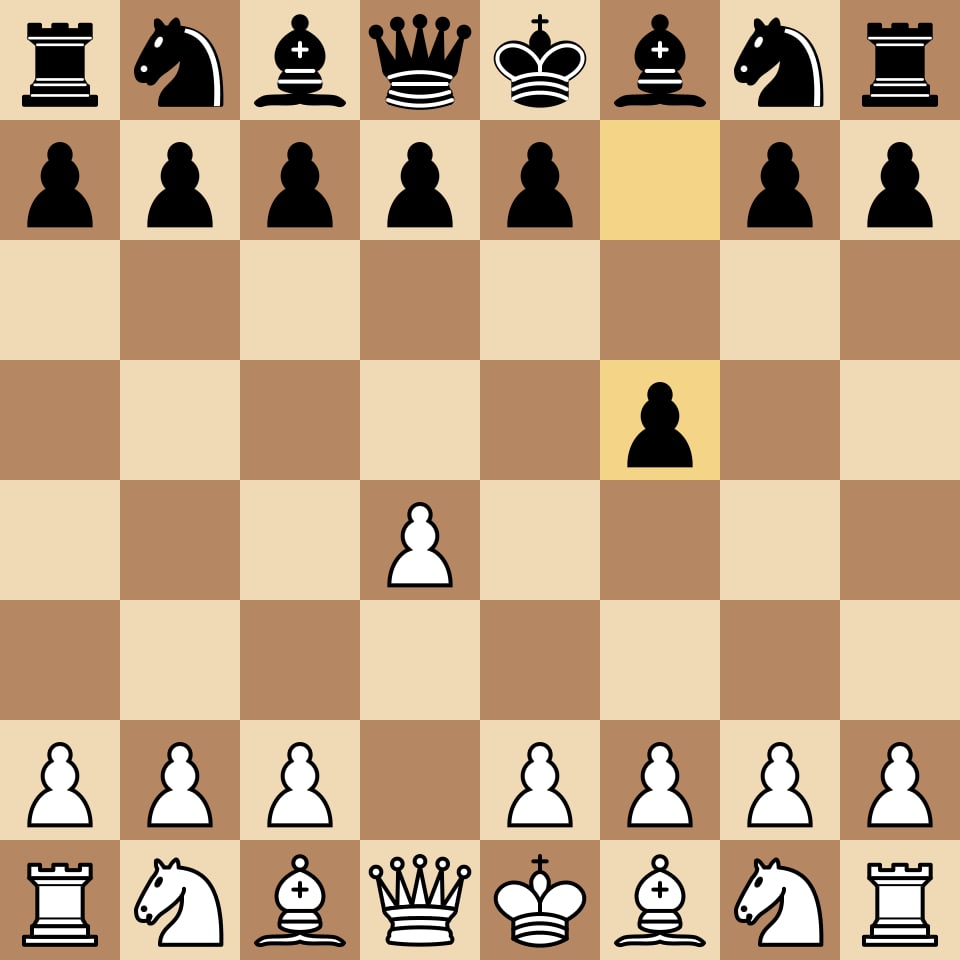
The Dutch Defense is 1.d4 f5. Black claims the e4 square with a pawn on move one and plays for a kingside attack later, which is unusual against 1.d4, where most defenses start by contesting the centre with …d5 or …Nf6. The cost is structural and permanent: the f-pawn has left f7, so the e8 to h5 diagonal is thinner than it should be and the king has less cover once it castles short. It runs from ECO A80 to A99 and splits into three systems that barely resemble each other.
Those three, the Leningrad, the Stonewall and the Classical, are different openings wearing one name. Picking between them matters more than any move-order detail inside them.
What is the Dutch Defense?
The idea is old and it was never a fringe one. Elias Stein, an Alsatian player who taught chess in the Netherlands, recommended 1…f5 in Nouvel essai sur le Jeu des échecs in 1789, which is where the name comes from. Siegbert Tarrasch, writing in 1931, dismissed it as unsound. Both verdicts have been out there for a long time, and the second one is still the folk opinion, which is roughly why the Dutch remains under-prepared against.
What Black actually buys with 1…f5 is control of e4. In most queen’s-pawn openings White eventually gets a knight or a pawn to e4 and Black spends the middlegame reacting to it. Here that never happens, because a pawn is sitting on f5 covering the square, and pawns do not get chased away by pieces. Everything else in the Dutch flows from that one purchase.
What does 1…f5 actually cost?
Two things, and it is worth being precise because they are usually described vaguely.
The first is the diagonal in the frontmatter caption above. The e8 to h5 diagonal runs e8, f7, g6, h5, and with the pawn on f5 instead of f7 the middle of that line is open. Black’s king still sits at the end of it. This is not usually fatal, and there is no move-two knockout, but it is why every anti-Dutch try in the book aims at the kingside rather than the centre: 2.e4, 2.g4, 2.h3 followed by 3.g4, 2.Bg5, 2.Nc3 with 3.Bg5. White is not attacking the f5 pawn for its own sake. White is attacking the shelter behind it.
The second is that 1…f5 develops nothing. In the Queen’s Gambit or the King’s Indian, Black’s first move either occupies the centre or brings out a knight. Here move one is a commitment with no piece behind it yet, so Black is a tempo behind schedule for the whole opening phase and has to be careful about it.
What Black does not lose is the centre. That is the trade, and whether it is a good one depends entirely on which system you choose next.
Which Dutch system should you play?
Leningrad Dutch
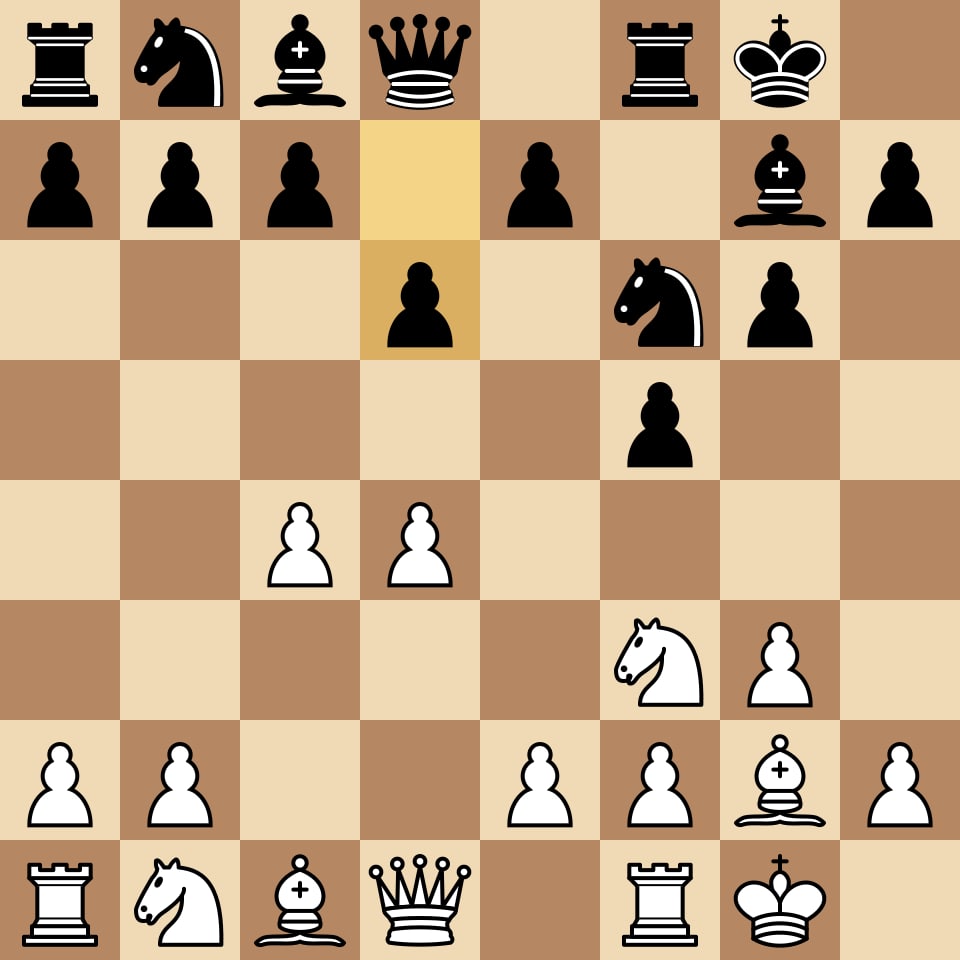
ECO A87 to A89. The move order is 1.d4 f5 2.c4 Nf6 3.g3 g6 4.Bg2 Bg7 5.Nf3 O-O 6.O-O d6, and the fianchetto is the answer to the diagonal problem. The bishop on g7 covers the dark squares around the king that the f-pawn abandoned, and the knight on f6 covers the light ones. The king is fine.
Then Black plays for …e5. That break is the entire point of the system, and Black will spend moves preparing it with …Qe8, …Nc6 or …c6 depending on what White does. If it lands, Black has two centre pawns and a bishop raking the long diagonal. If White prevents it permanently, Black is worse.
This is the version modern grandmasters actually play. In the PGN Mentor collection of Hikaru Nakamura’s games, the Dutch appears 148 times as Black between 2006 and 2026, mostly in Leningrad form. That is not a surprise weapon, that is a main defense.
Here is one of them, against Boris Gelfand at Wijk aan Zee in January 2012, four months before Gelfand played Anand for the world championship.
Gelfand, Boris White Nakamura, Hikaru Black


Notice how little of that game is a kingside attack. Nakamura got …e5 in on move 8, traded into a position with mobile centre pawns, and won with them. The Dutch has an attacking reputation and this is what it actually looks like most of the time.
Stonewall Dutch
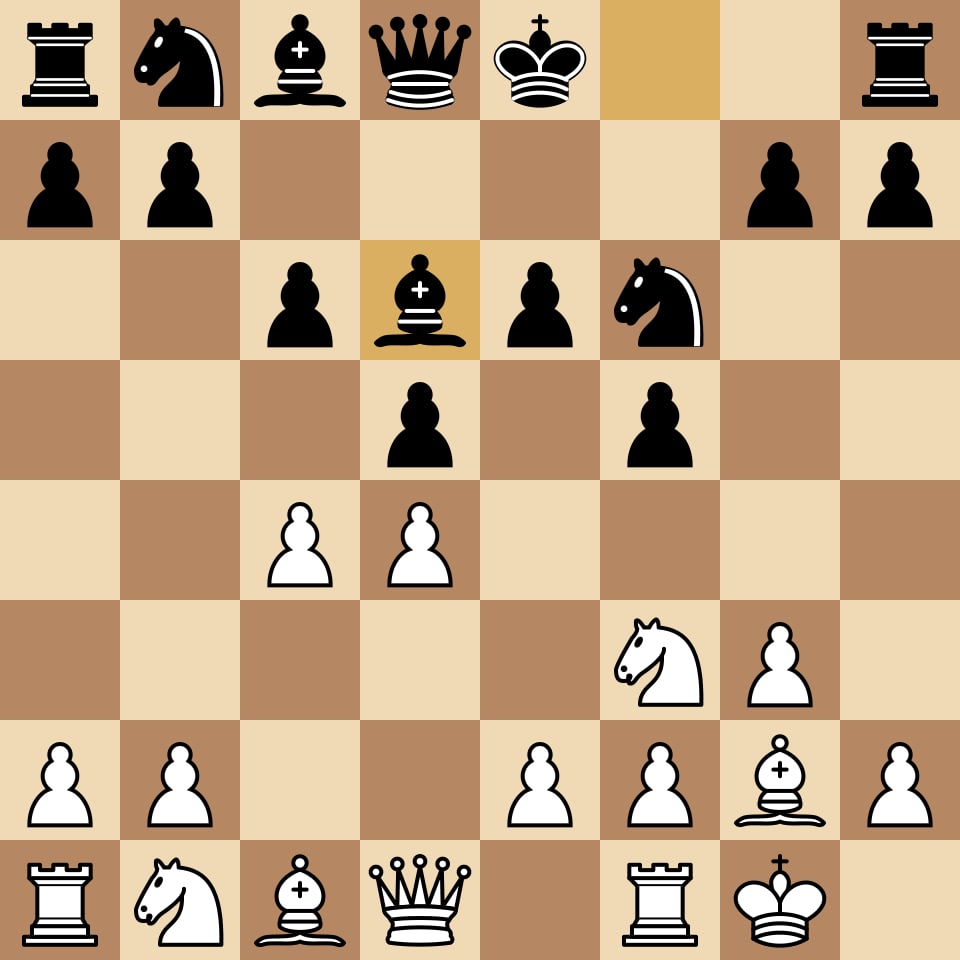
ECO A90 to A92. The move order is 1.d4 f5 2.g3 Nf6 3.Bg2 e6 4.c4 c6 5.Nf3 d5, and the pawn chain that results is the most committal structure in the whole opening. Black owns e4 permanently. Nobody is dislodging four pawns.
The bill is equally permanent. The e5 square is a hole and White’s knight wants to live there. And the bishop on c8 is stuck behind its own pawns on e6 and f5, which is the same problem the French Defense has, except harder to solve because f5 blocks the other exit too.
The old treatment put the dark-squared bishop on e7 and accepted a passive game. The modern one, developed through the 1980s and 1990s by Artur Yusupov, Sergey Dolmatov, Nigel Short and Simen Agdestein, puts it on d6, where it points at h2 and covers e5. That one square of difference is what took the Stonewall from a club opening back into elite practice.
Magnus Carlsen has beaten world champions with it twice in one season. He played the Stonewall as Black against Viswanathan Anand at the GRENKE Chess Classic on 6 February 2015 and won, and against Fabiano Caruana at the Vugar Gashimov Memorial on 19 April 2015 and won that too. Both games followed the same modern move order with …Bd6.
Classical Dutch
ECO A90 to A99. The move order is 1.d4 f5 2.c4 Nf6 3.g3 e6 4.Bg2 Be7 5.Nf3 O-O 6.O-O d6, and it is the version closest to the opening’s original intent. No fianchetto, no locked pawn chain, just development followed by …Qe8 and …Qh5 or …Qg6 and an attack down the h-file if White lets it happen.
It is the least fashionable of the three and the most fun to play.

Mikhail Botvinnik and David Bronstein both used the Dutch in their 1951 world championship match, which is a useful data point on how seriously it was taken at the top in that era. Alexander Alekhine played it, Bent Larsen played it constantly, and in the PGN Mentor collection Larsen has 47 Dutch games as Black between 1956 and 1997. The English grandmaster Simon Williams has written several books on the Classical and is the main reason it still has an audience.
How do you handle the Staunton Gambit?
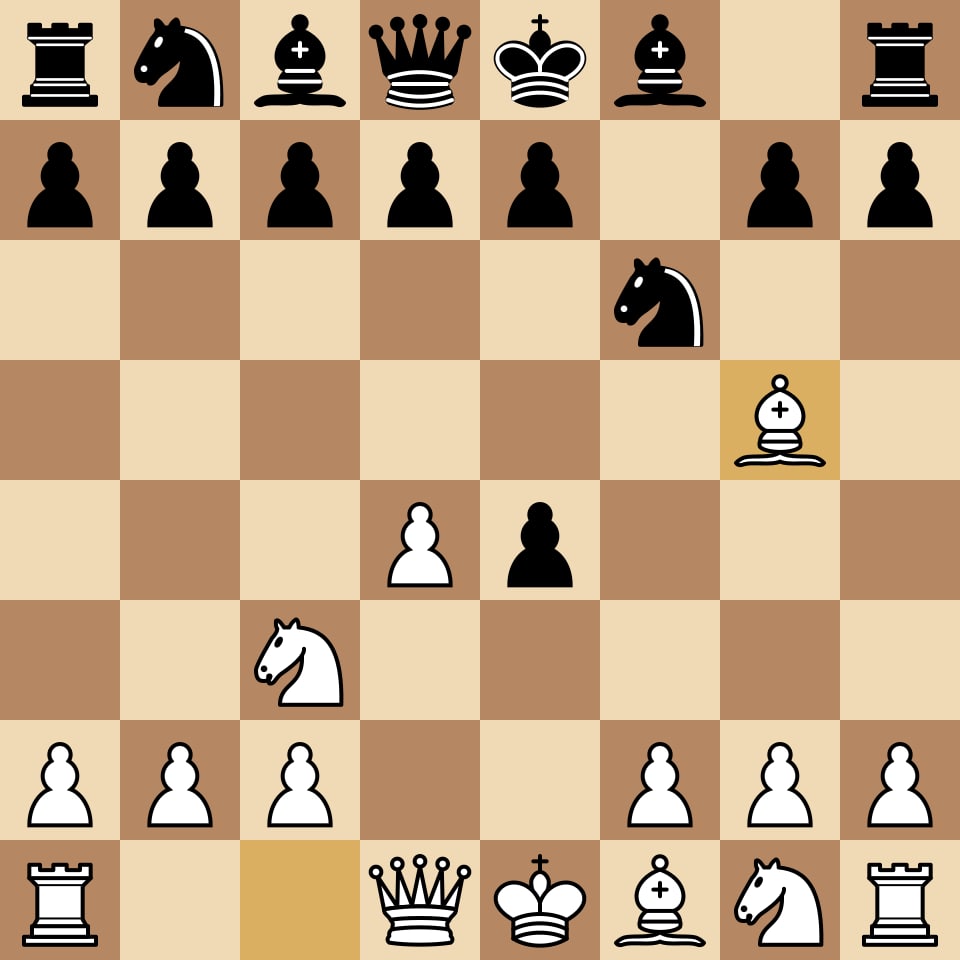
2.e4 is the main anti-Dutch attempt and the one every Dutch player has to know. After 2…fxe4 3.Nc3 Nf6 4.Bg5, White has spent a pawn on a lead in development and a pin, aimed at the same diagonal that 1…f5 opened. It was a feared line into the 1920s and has been out of favour since, with the modern assessment being that it gets White equality at best.
That assessment is for people who have looked at it. Face it cold at a weekend tournament, a pawn up with your king on e8 and a bishop pinning your only developed piece, and it is a different experience. Know the first eight moves.
There is also a move-order answer, and plenty of Dutch players use it: begin 1…e6 and play …f5 on move two. After 1.d4 e6 2.c4 f5 you have a normal Dutch, and White never got the chance to play 2.e4 at all. The catch arrives one move earlier. Meet 1.d4 with 1…e6 and White can answer 2.e4, which is not a gambit and not a Dutch, it is a French Defense. So the move order works only if you are happy to play a French some of the time. If you are not, it hands the choice to your opponent, which is worse than learning eight moves of Staunton.
The rest of the anti-Dutch menu is smaller and worth a paragraph rather than a chapter. 2.Bg5 is the Hopton Attack, which skips the pawn sacrifice and just develops with tempo. 2.Nc3 followed by 3.Bg5 is the Raphael Variation, aiming for e4 with a piece behind it. 2.h3 with 3.g4 is the Korchnoi Attack, brought back into practice in 1979, and 2.g4 is the Krejcik Gambit, which is the same idea with the safety catch off. 2.Qd3 is the Alapin. None of these refute anything. All of them are more common at club level than the main lines, because they are cheap to learn and Dutch players usually prepare against 2.c4 and 2.g3 instead.
Is the Dutch a good practical choice?
It is a good choice if you actually want an unbalanced game as Black and you are willing to learn one system properly rather than three badly. Pick the Leningrad if you like the King’s Indian and want the same fianchetto with a different centre. Pick the Stonewall if you are comfortable playing one plan for forty moves and grinding. Pick the Classical if you want to attack and do not mind losing some games doing it.
What it is not is a low-maintenance defense. The structural cost is real, White has half a dozen sideline tries that all arrive early, and unlike the Caro-Kann there is no version of the Dutch where you can play the first ten moves on general principles and be fine. If your study time is limited, that matters more than the opening’s objective evaluation does. Our chess openings guide covers how to make that call across a whole repertoire, and the improvement guide covers how much opening study is worth at your level in the first place.
For the middlegame the Dutch is aiming at, Logical Chess: Move by Move (affiliate) annotates kingside attacks move by move with the reason for each one stated out loud. And because the Stonewall in particular is a permanent trade of one square for another, How to Reassess Your Chess (affiliate) is the book that explains how to judge whether you got the better end of it.
Tarrasch called 1…f5 unsound in 1931. Carlsen used it to beat two world champions in ten weeks in 2015. Somebody has been wrong for ninety years.
Sources
- Wikipedia. “Dutch Defence.” ECO A80 to A99, Leningrad, Stonewall and Classical move orders, Staunton Gambit and the anti-Dutch second moves, Elias Stein’s 1789 recommendation, Tarrasch’s 1931 assessment, the modern Stonewall revival and the list of practitioners.
- Boris Gelfand vs Hikaru Nakamura, Wijk aan Zee 2012, chessgames.com Game score, cross-checked against the Nakamura collection at PGN Mentor.
- Wikipedia. “World Chess Championship 2012.” Gelfand as challenger against Anand, Moscow, 10 to 31 May 2012.
- PGN Mentor game collections. Source for the game counts quoted above (Nakamura, 148 Dutch games as Black 2006 to 2026; Larsen, 47 between 1956 and 1997) and for Carlsen’s Stonewall wins over Anand at the GRENKE Chess Classic on 6 February 2015 and over Caruana at the Vugar Gashimov Memorial on 19 April 2015.
- Chernev, Irving. Logical Chess: Move by Move. Batsford. (affiliate)
- Silman, Jeremy. How to Reassess Your Chess, 4th edition. Siles Press, 2010. (affiliate)
This page contains affiliate links. As an Amazon Associate, DiscussChess earns from qualifying purchases.
Sources
- Wikipedia. "Dutch Defence." (move order, ECO A80-A99, Leningrad, Stonewall and Classical systems, Staunton Gambit and anti-Dutch lines, Elias Stein 1789, Tarrasch's 1931 assessment, practitioners)
- Boris Gelfand vs Hikaru Nakamura, 74th Tata Steel Group A, Wijk aan Zee, round 6, 20 January 2012 (game score)
- Wikipedia. "World Chess Championship 2012." (Gelfand as challenger, Moscow, 10-31 May 2012)
- PGN Mentor game collections for Carlsen, Larsen and Nakamura (Dutch game counts and the 2015 Stonewall wins)
Further reading
- How to Reassess Your Chess (4th ed.), Jeremy Silman (Siles Press, 2010) ASIN verified via Open Library 2026-08-07 (record returns How to reassess your chess, Jeremy Silman, Siles Press, 2010). The Stonewall is a permanent trade of one square for another, which is exactly the kind of static imbalance Silman's method is built to evaluate.
- Logical Chess: Move by Move, Irving Chernev (Batsford) ASIN verified via Open Library 2026-08-07 (record returns Logical Chess, Move by Move, Irving Chernev, Batsford). Chernev's annotated kingside attacks are the clearest illustration of the attacking pattern the Dutch is aiming at from move one.