King's Indian Defense: The Complete Opening Guide
A complete guide to the King's Indian Defense: why Black lets White build the pawn center to destroy it, the five main variations, how Kasparov used it as a championship weapon, and what every serious player needs to know.
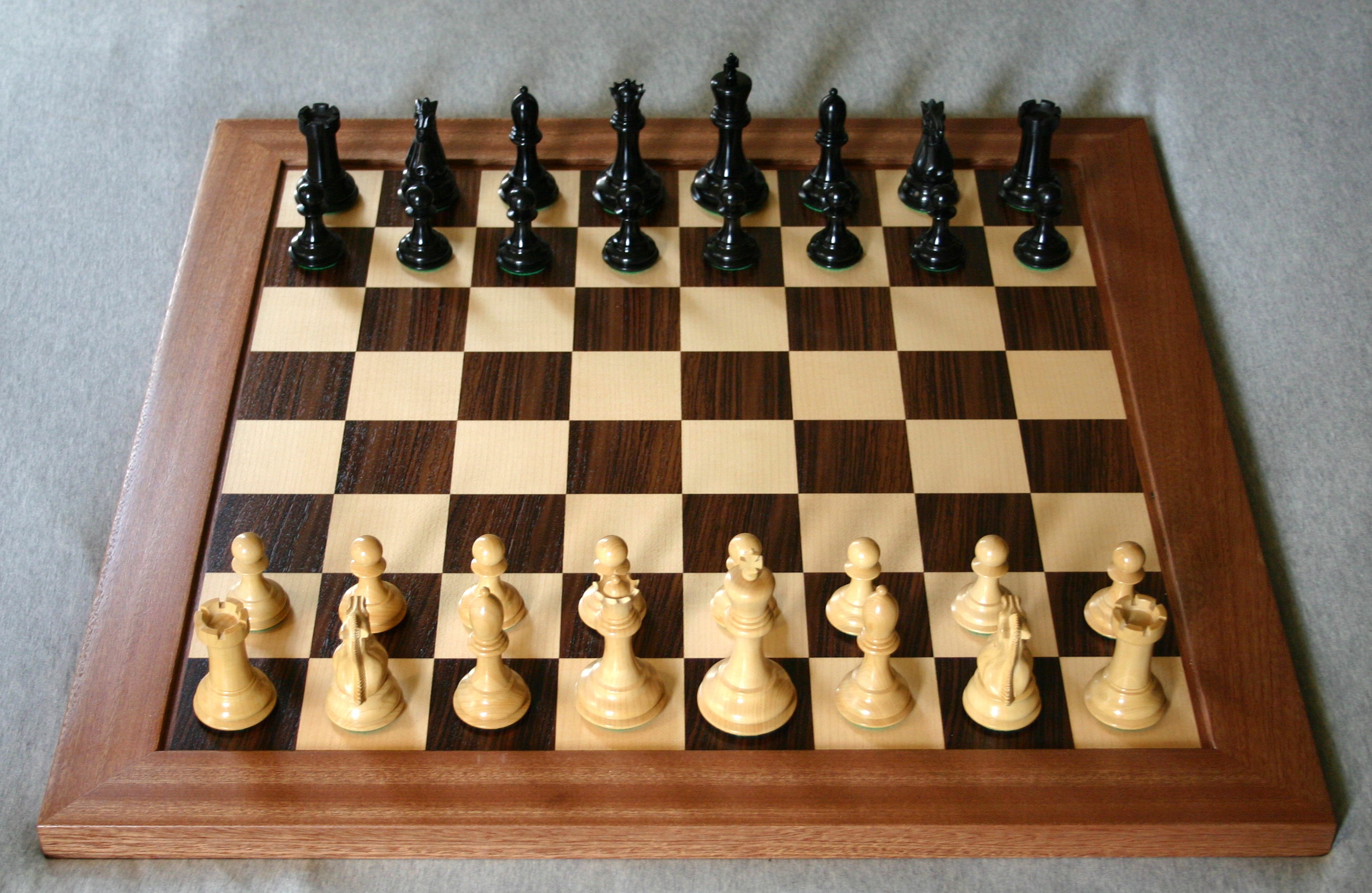
The King’s Indian Defense begins 1.d4 Nf6 2.c4 g6 3.Nc3 Bg7. Black fianchettoes the dark-squared bishop and allows White to build the full d4-e4 pawn center. Then Black attacks it. The …e5 break in the Classical variation and the …c5 break in the Averbakh and Four Pawns Attack create immediate tension against White’s center before it becomes permanent. The resulting middlegames are among the most combative in chess. Both sides attack on opposite wings, and the game is often decided by who breaks through first.
Garry Kasparov played the King’s Indian as Black throughout his championship career. Bobby Fischer played it. So did Mikhail Tal, whose attacking instincts suited the opening perfectly. David Bronstein and Isaac Boleslavsky developed it theoretically in the 1940s and 1950s, demonstrating that a hypermodern defense, Black conceding the center temporarily, could produce winning attacks rather than passive defense. Hikaru Nakamura and Maxime Vachier-Lagrave still bring it out regularly at the top level today. The opening is not for players who prefer quiet, maneuvering positions. It’s for players who want to win.
The hypermodern philosophy made concrete
The King’s Indian is one of the clearest examples of hypermodern opening theory. Classical chess theory, from Steinitz through Tarrasch, held that controlling the center with pawns (d4 and e4 for White) was the highest priority. The hypermodern school, which emerged in the 1920s, argued that a pawn center could be a target. Better to let White build it and then attack it from the flanks.
In the King’s Indian, Black lets White place pawns on d4 and e4, then plays …e5 (in the Classical variation) or …c5 (in others) to challenge them directly. The fianchettoed bishop on g7 becomes the attacking weapon: in the Classical variation, after White advances e5 and Black plays …Ne8 followed by …f5-f4, the bishop on g7 aims powerfully at White’s queenside down the a1-h8 diagonal.
The positions that result require concrete calculation. Unlike the London System or Caro-Kann Defense, where slow maneuvering often determines outcomes, King’s Indian games are frequently decided by who miscalculates a king attack first.
The five main variations
Classical Variation (5.Nf3 0-0 6.Be2 e5 7.0-0): The most popular and most deeply analyzed. After 7…Nc6 8.d5 Ne7, Black’s knight maneuvers to f5 via d7 and e5 or prepares the …f5-f4 pawn storm. White plays c5 and queenside pressure. Both sides race. Games in the Classical KID often feature both kings under direct attack simultaneously; the outcome depends on which attack is one tempo faster.
Sämisch Variation (5.f3). White immediately attacks Black’s planned …e5 by preparing e4 expansion. The f3 pawn prevents …Ng4 and supports a broad pawn advance. Black responds with …0-0 and …c5 or …e5, and the resulting positions are sharper than the Classical, White’s f3 pawn creates kingside weaknesses that Black targets aggressively.
Four Pawns Attack (5.f4). White grabs space aggressively with four central pawns (c4, d4, e4, f4). The setup looks menacing, but it’s also overextended. Black typically plays …0-0…c5, and …cxd4, opening lines to challenge White’s broad center. The positions are double-edged and somewhat out of fashion at the top level but still surprise opponents at club level.
Averbakh Variation (5.Be2 0-0 6.Bg5). White develops the bishop aggressively before committing the knight, aiming to prevent …e5 by attacking the f6 knight. Black responds with …h6 (trading the bishop pair at the cost of weakening the kingside) or …c5 (challenging the center directly). Less theoretical than the Classical but still complex.
Fianchetto Variation (5.Nf3 0-0 6.g3). White fianchettoes the bishop to g2, creating a symmetrical setup. The game becomes a battle of bishop diagonals and piece activity rather than a direct kingside vs. queenside race. More positional than the Classical; less explosive but still competitive.
Kasparov’s King’s Indian
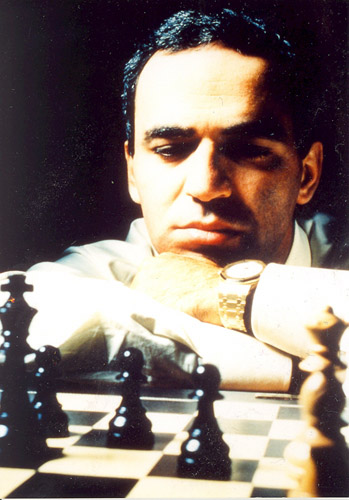
The Kasparov-Karpov matches produced some of the most important King’s Indian games ever played. Kasparov used the Classical KID in multiple games across their four classical championship matches, developing new ideas against Karpov’s precise positional handling. The g7 bishop’s power in the endgame (after most pieces come off, it controls a long diagonal that Black’s queenside advances can exploit) was a theme Kasparov understood deeply.
His annotations in My Great Predecessors, Part 1 (Everyman Chess, 2003) cover the predecessors who established King’s Indian theory: Boleslavsky, Bronstein, and others who demonstrated in the 1940s and 1950s that Black’s attacking chances were genuine, not speculative. Kasparov’s games built on their theoretical foundation.
Practical advice for club players
The King’s Indian is a high-reward, high-risk opening, and not the easiest starting point for a new 1.d4 defense. Players who haven’t yet internalized the basics tend to do better with the Caro-Kann against 1.e4 or the Queen’s Gambit Declined against 1.d4; the King’s Indian rewards players who already have the fundamentals down and want something sharper. Learn the Classical variation first: it’s the most important and the most instructive. Understand both plans: White’s c5 queenside expansion and Black’s …f5-f4 kingside attack. Know when to play …Ne8 (centralizing the knight before the kingside attack) versus …Nbd7 (supporting the queenside).
The Mar del Plata variation within the Classical (7…Nc6 8.d5 Ne7 9.Ne1 Nd7 10.f3) is the most explosive and most demanding theoretically. It’s where the most interesting King’s Indian ideas live but also requires the most specific preparation. Start with the quieter Classical lines before going into the Mar del Plata.
The Sämisch is worth preparing against because White’s f3 move can catch unprepared players. Know that …c5 and …cxd4 is the standard response, and that Black has strong counterattacking resources despite White’s imposing pawn center.
For the accessible introduction, Starting Out: King’s Indian by Joe Gallagher (Everyman Chess) explains the strategic logic of both sides before going into variations: the right way to approach a complex opening.
The King’s Indian and the Nimzo-Indian Defense both answer 1.d4, but the logic behind them is nearly opposite. The King’s Indian lets White build the full d4-e4 center and attacks it later; the Nimzo-Indian (1.d4 Nf6 2.c4 e6 3.Nc3 Bb4) pins the c3 knight and disrupts the center before it ever forms. The King’s Indian is the more aggressive, more committal choice of the two. Against 1.e4, the Sicilian Defense plays a similar combative role for Black.
Sources
- Gallagher, Joe. Starting Out: King’s Indian. Everyman Chess, 2002.
- Kasparov, Garry. My Great Predecessors, Part 1. Everyman Chess, 2003.
- Nunn, John. Nunn’s Chess Openings. Everyman Chess / Gambit, 1999.
This page contains affiliate links. As an Amazon Associate, DiscussChess earns from qualifying purchases.
Sources
- Gallagher, Joe. Starting Out: King's Indian. Everyman Chess, 2002.
- Kasparov, Garry. My Great Predecessors, Part 1. Everyman Chess, 2003.
- Nunn, John. Nunn's Chess Openings. Everyman Chess / Gambit, 1999.
- ChessBase Opening Encyclopedia, King's Indian ECO codes E60–E99
Further reading
- Starting Out: King's Indian, Joe Gallagher (Everyman Chess, 2002) ASIN verified via Open Library 2026-05-02. Everyman Chess 2002 edition. The most accessible introductory text on the King's Indian, explains the strategic logic of both sides before getting into the variations.
- Garry Kasparov on My Great Predecessors, Part 1, Everyman Chess, 2003 ASIN verified via Open Library 2026-05-02. Covers the King's Indian's history and the pioneers who established its theory: essential background for the opening's strategic ideas.