The Immortal Game: Anderssen vs. Kieseritzky
Anderssen vs. Kieseritzky, London 1851: the casual game where White gave up both rooks, a bishop, and the queen and still won. Why this 175-year-old game is still the standard for brilliancy.
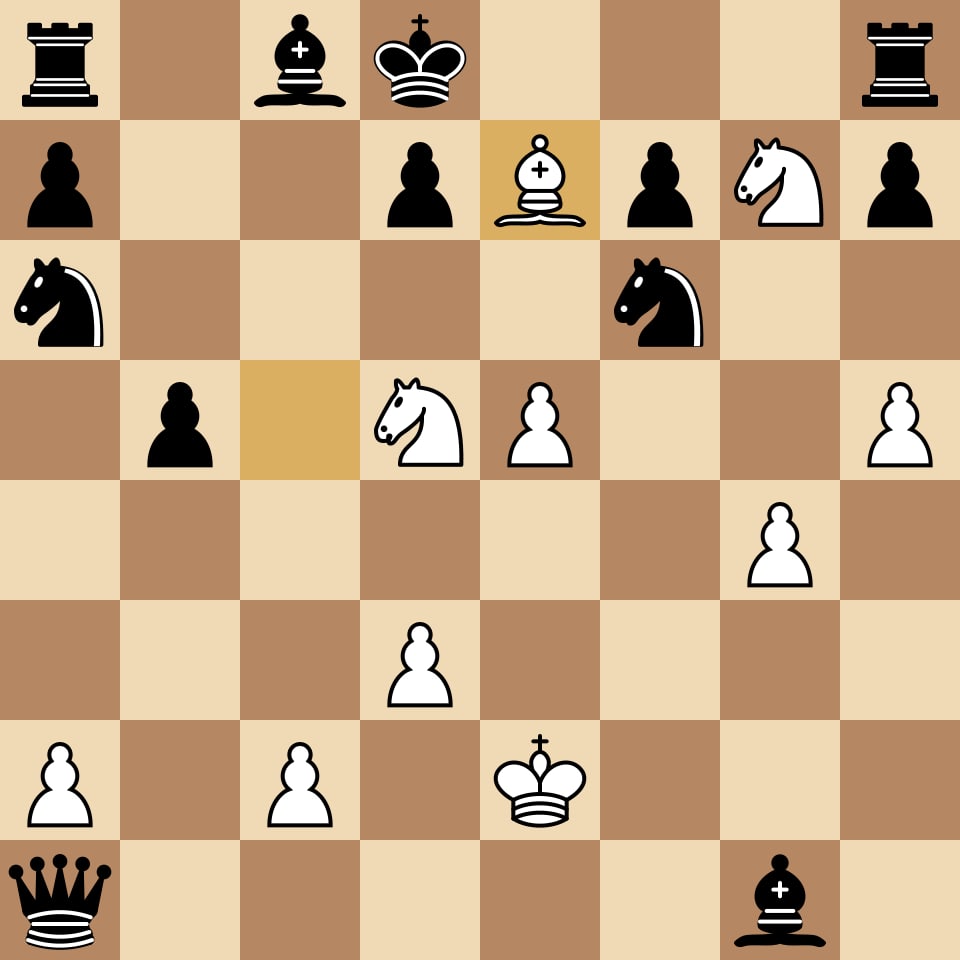
The Immortal Game is a casual game played in June 1851, between rounds of the London International Chess Tournament. Adolf Anderssen sacrificed both rooks, a bishop, and then his queen, and still won on move 23. Howard Staunton published it in The Chess Player’s Chronicle the same year. Ernst Falkbeer called it “the immortal game” in the German chess magazine Deutsches Schachzeitung in 1855, and the name stuck.
It’s been analyzed continuously ever since. Not because the play is flawless by modern engine standards, computers find improvements for both sides, but because the sacrifices are motivated by a forced idea that Anderssen calculated completely over the board in 1851 without any modern tools.
The game
The opening is a King’s Gambit Accepted. White offers the f-pawn on move 2; Black takes it; White develops aggressively toward Black’s exposed king.
Lionel Kieseritzky plays 3…Qh4+, the Kieseritzky Gambit line, which forces White’s king to f1 immediately. What follows is 20 moves of Anderssen finding threatening squares and Kieseritzky accumulating material while falling steadily further behind in development. By move 11 Anderssen has left his h1 rook on g1 en prise. Kieseritzky takes the b5 pawn instead. The rook stays.
Between moves 12 and 19, Anderssen keeps handing Kieseritzky material while Kieseritzky keeps taking it. 12.h4 and 13.h5 chase Black’s queen around the kingside; 15.Bxf4 recovers the original gambit pawn and develops with a threat on Black’s queen at the same time. Then comes the real giveaway: 17.Nd5, attacking Black’s queen, and Kieseritzky answers 17…Qxb2, grabbing a second pawn instead of retreating to safety. Anderssen’s reply, 18.Bd6, is the quietest-looking move in the entire combination: no capture, no check, just a bishop cutting off every square Black’s king or queen could use to get back into the game. Kieseritzky, still hunting material, plays 18…Bxg1, taking a full rook. Anderssen opens the center with 19.e5, and Kieseritzky takes the other rook with check: 19…Qxa1+. By this point Kieseritzky has two extra rooks and a bishop’s worth of material sitting in his pocket. He also has a queen and a king with nowhere safe left to go, which is the only material count that ends up mattering.
On move 22, with Kieseritzky holding two extra rooks, Anderssen plays Qf6+: a queen sacrifice. After 22…Nxf6, the knight that was guarding against Be7 is gone. 23.Be7 is checkmate.
Anderssen White Kieseritzky Black


Why the sacrifices work
By move 11, Anderssen has left his h1 rook hanging. Kieseritzky plays 11…cxb5 cautiously, declining it, which turns out to be a mistake of a different kind. The position is already uncomfortable for Black because the development lag is severe.
The queen sacrifice on move 22 is the culmination of a forced sequence. By that point Kieseritzky’s king is on d8, his pieces are scattered, and Anderssen has Be7 available. The check 22.Qf6+ strips the knight on f6, which was the last piece preventing Be7, and mate follows on the next move regardless of what Black does.
What makes this a brilliancy and not a blunder is that Anderssen could see that conclusion before giving up the rooks. The material sacrifices aren’t speculative. They’re the setup for a mate calculated in full in advance.
Why this game still matters
Two reasons. First, it was played in 1851. No engines, no databases, no prepared lines. The calculation was entirely over the board, in a casual game, between rounds of a tournament Anderssen was also winning.
Second, it’s one of the clearest illustrations of a principle that took decades to formally articulate: king safety and development can be worth more than material. Kieseritzky had two extra rooks. His king had no safe squares. Material evaluations that ignore king exposure were insufficient then and they’re insufficient now. The players who understand this principle (Bobby Fischer, Garry Kasparov, and every strong attacking player since) build on the logical foundation that Anderssen demonstrated here.
The historical context
The London 1851 tournament was organized by Howard Staunton, the dominant English player of the era, and is generally considered the first true international chess tournament, a strong candidate for the first unofficial world championship as well. Sixteen players, single-elimination knockout. Anderssen, a relatively unheralded German mathematics teacher going in, beat Staunton himself 4–1 in the semifinal, then beat Marmaduke Wyvill in the final to take the title. The tournament established the basic competitive chess format that persisted through the rest of the 19th century, and it made Anderssen’s reputation overnight: he went from a name known mostly in German chess circles to the player most Europeans considered the strongest in the world, a status he held until Paul Morphy’s 1858 tour (the same tour that produced the Opera Game) briefly upended it.
The game against Kieseritzky was played informally during the tournament, not as part of the official competition. Kieseritzky, born in what’s now Estonia, had moved to Paris in 1839, given up a stable career as a mathematics teacher, and made his living charging five francs an hour for chess lessons and five francs a game to anyone who’d challenge him at the Café de la Régence. Ten years after arriving, he founded his own chess magazine, La Régence, and it was there that he published the game himself. He apparently didn’t think he had played badly. He did have the material advantage, after all.
Kieseritzky didn’t get to enjoy his role in chess history for long. He died in Paris on May 18, 1853, less than two years after the Immortal Game, penniless, in a public hospital that served the city’s poor, and was buried in a pauper’s grave. The Paris chess community passed a hat around the Café de la Régence to cover a modest funeral. The game he lost outlived him by more than a century and a half, and it’s the reason his name is still recognized by people who’ve never heard of the tournament he helped run or the magazine he founded.
The Evergreen Game (Anderssen vs. Dufresne, 1852) is sometimes called its companion piece. Between them, the two games established Anderssen’s reputation as the dominant attacking genius of the pre-Steinitz era. For more context on the games that shaped chess history, see the Magnus Carlsen biography and our chess improvement guide for how these tactical patterns translate to modern club play. The sacrificial themes in the Immortal Game (removing the defender, exploiting a trapped king) appear in Logical Chess: Move by Move (Amazon, affiliate), which annotates games precisely to show this kind of reasoning at work.
Sources
- Staunton, Howard. The Chess Player’s Chronicle, 1851. (First publication of the game score.)
- Falkbeer, Ernst. Deutsches Schachzeitung, 1855. (First documented use of “the immortal game.”)
- Hooper, David, and Kenneth Whyld. The Oxford Companion to Chess. Oxford University Press, 1992.
- The Immortal Game, Lichess study (PGN source)
This page contains affiliate links. As an Amazon Associate, DiscussChess earns from qualifying purchases.
Sources
- Staunton, Howard. The Chess Player's Chronicle, 1851. (First publication of the game.)
- Hooper, David, and Kenneth Whyld. The Oxford Companion to Chess. Oxford University Press, 1992.
- Falkbeer, Ernst. Deutsches Schachzeitung, 1855. (First use of 'immortal game' as a name.)
- The Immortal Game, Lichess study (PGN source)
- London 1851 chess tournament, Wikipedia
- Lionel Kieseritzky, Wikipedia
Further reading
- The Life and Games of Mikhail Tal, Mikhail Tal, Everyman Chess, 1997 ASIN verified via Open Library 2026-05-02. Tal's own annotated sacrificial games: the natural next read after the Immortal Game.
- My 60 Memorable Games, Bobby Fischer, Batsford/Pavilion edition ASIN verified via Open Library 2026-05-02. Fischer's Najdorf annotations show the same sacrificial logic documented 100 years later.