Divya Deshmukh: The 15th Seed Who Won the World Cup
Divya Deshmukh entered the 2025 FIDE Women's World Cup as the 15th seed and won it, beating the 2nd, 3rd and 10th seeds on the way and Koneru Humpy in the final. The win made her a grandmaster outright at 19, the youngest champion in the event's history. A biography.

Divya Deshmukh won the 2025 FIDE Women’s World Cup as the fifteenth seed in a field of a hundred and seven. She was 19. The win carried the grandmaster title automatically, no norms required, which made her India’s 88th grandmaster and the fourth Indian woman to hold the title. Born December 9, 2005 in Nagpur, she is rated 2490 as of August 2026, with a peak of 2510 in April.
The seeding is the whole story. To win a knockout you have to keep beating people, and the people she beat were the second seed Zhu Jiner, the tenth seed Harika Dronavalli, the third seed Tan Zhongyi, and then Koneru Humpy, the fourth seed and the most decorated Indian woman player in history, in a tiebreak final she took 1½–½. Three of the top four seeds in one event, by a teenager nobody had picked.
Ten years of winning her age group
Divya grew up in Nagpur, in Maharashtra, the daughter of two doctors. She was winning age-group events before she was ten and the pattern held: National Women’s Champion in 2022 at 16, Asian Continental Women’s Champion in 2023, World Junior Girls Champion in 2024, the fourth Indian to take that title.
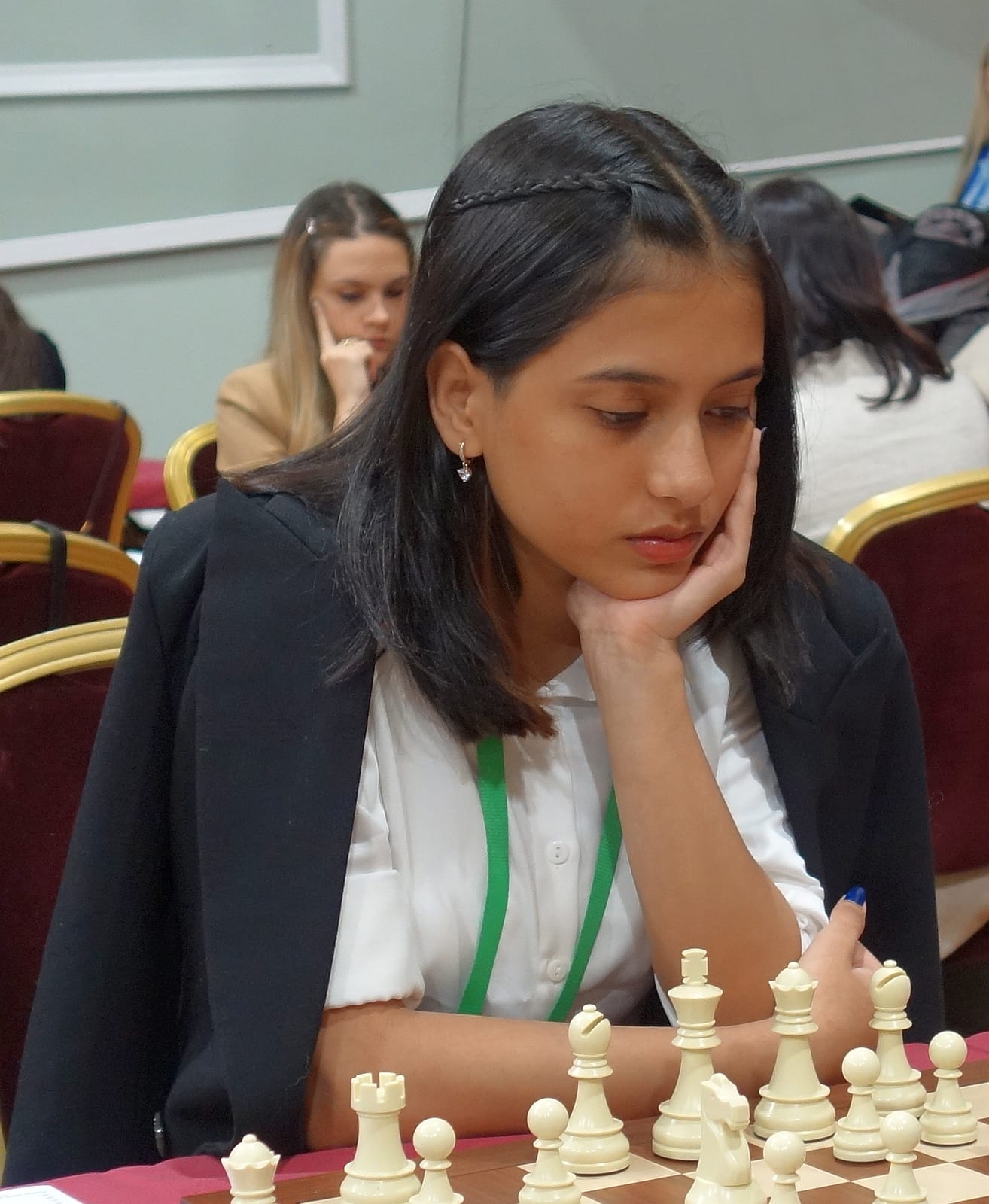
The Olympiad results are the ones that should have been the warning. She took an individual bronze at the 2022 Olympiad, then at Budapest in 2024 she scored 9½ out of 11 on board three for the gold-medal Indian team, a performance rating of 2608 against a field where her own rating was several hundred points lower. India won the women’s event outright. Divya won individual gold on her board.
The 2025 World Cup
The Women’s World Cup is a knockout, which means it rewards a particular temperament rather than a particular rating. You get two classical games against one opponent, and if those are drawn you go to rapid, and if those are drawn you go faster still. A player who is willing to keep complicating has more chances than a player trying to hold.
Divya kept complicating. She went through Zhu Jiner, Harika Dronavalli and Tan Zhongyi, a former Women’s World Champion, and arrived in a final against Koneru Humpy that was an all-Indian affair and a generational one: Humpy has been a grandmaster since 2002, three years before Divya was born.
The classical games were drawn. Divya took the two rapid tiebreak games 1½–½, drawing the first and winning the second.
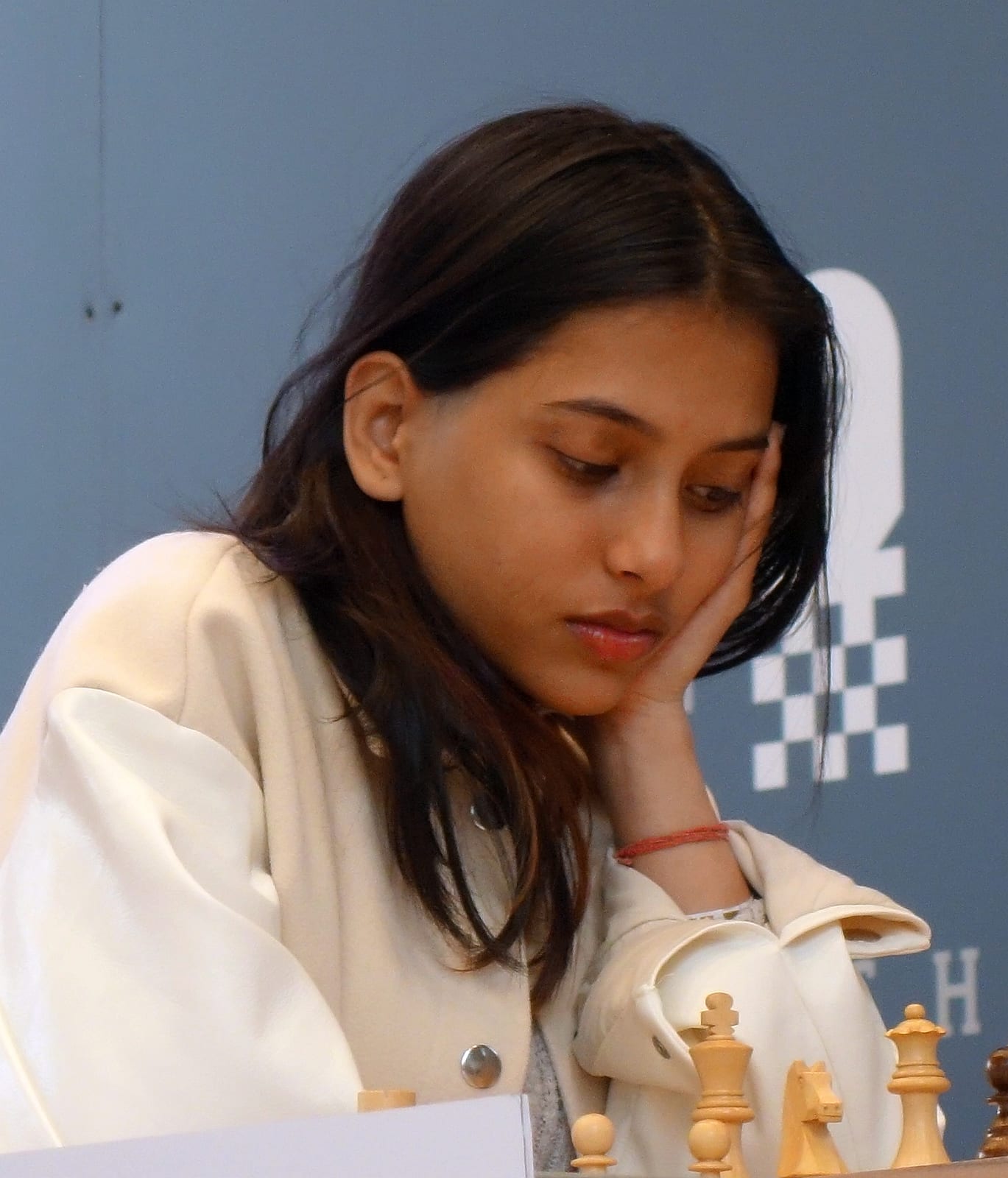
The win qualified her directly for the Women’s Candidates Tournament in Cyprus in 2026, the event that decides who challenges Ju Wenjun for the world title.
What happened at the Candidates
She finished seventh out of eight, on 5½ out of 14.
That result belongs in the article as plainly as the World Cup does. A knockout and a fourteen-round round-robin ask for different things, and the qualities that make a player dangerous across two games against one opponent are not the same qualities that keep a score above fifty percent for three weeks. Vaishali Rameshbabu won that event on 8½/14 and will play the title match. Divya was 20 and the youngest player in the field.
The rest of 2026 has been closer to the Olympiad form than the Candidates form: fifth at Norway Chess Women, gold on board two at the European Chess Club Cup with 4½/6, and an invitation to the Cairns Cup in Saint Louis, one of the strongest women’s tournaments in the world, alongside Humpy, Tan Zhongyi, Assaubayeva and Muzychuk.
Playing style: complications on purpose
Divya plays sharp openings and she does not steer for symmetry. She meets 1.e4 with the Sicilian, she takes material when it is offered even when it costs her time, and she is comfortable in positions where both sides have chances to go wrong. That last part matters more than it sounds. Plenty of players can calculate; fewer are willing to enter a position where the calculation has to be right.
The cost is visible in her games. She blunders in sharp positions, sometimes badly, and she wins them anyway because her opponents blunder too and she is usually the one who recovers first. The game below has both halves of that in the space of three moves.
A signature game: Kosteniuk vs. Divya, Cairns Cup 2026
Round 3 in Saint Louis, August 12, 2026. Alexandra Kosteniuk, Women’s World Champion from 2008 to 2010, had White. Divya had Black and was rated fourteen points below her.
Kosteniuk played the Closed Sicilian and got nothing from it. By move 12 Divya had taken a pawn on e4 with her bishop, and by move 19 the position had turned sharply against White. Then the interesting part. On move 20 Kosteniuk grabbed the a-pawn with her queen, walking into a position that was close to lost, and Divya immediately played the wrong bishop move and gave most of it back. One move later Kosteniuk returned the favour. That three-move sequence, mistake into blunder into blunder, is the whole game, and it is a fairer picture of top-level chess than a clean brilliancy would be.
From move 22 Divya took over. She traded into an ending where her extra material and her passed pawns on the kingside were simply too much, and Kosteniuk’s own passed a-pawn arrived a move too late.
Kosteniuk, Alexandra White Divya Deshmukh Black


Kosteniuk resigned on move 55. It was Divya’s second win of the event and it came directly after a round 2 loss to Alice Lee, which is the pattern the whole profile keeps returning to: she loses games she should not and beats people she should not, often in the same week.
If you want to train the pattern recognition that lets a player survive positions like the one after move 20, the standard modern method is spaced repetition of the same tactical set until the motifs are automatic. The Woodpecker Method by Axel Smith and Hans Tikkanen is the book that codified it, and it is built for exactly this: not learning new tactics, but making known ones instant. For the temperament rather than the technique, The Life and Games of Mikhail Tal is still the best argument ever written for entering complications on purpose. More options in the best chess tactics books.

The ceiling question
She is 20, rated 2490, and the youngest player in almost every elite field she enters. The Candidates result put a ceiling question on her that the World Cup had briefly removed, and the honest answer is that nobody knows yet: knockout chess and round-robin chess are different sports, and she has now proved she is excellent at one of them.
The near-term measure is the Cairns Cup, running through August 19, where she is playing a nine-round round-robin against most of the players who finished above her in Cyprus. It is the same test she failed four months ago, which makes it the most informative thing on her calendar.
For the wider context of where she came from, see our piece on the Indian chess generation and India’s 2024 Olympiad double gold.
Sources
This page contains affiliate links. As an Amazon Associate, DiscussChess earns from qualifying purchases.
Sources
Further reading
- The Woodpecker Method, Axel Smith and Hans Tikkanen ASIN verified via Open Library 2026-08-15. Quality Chess, 2019. The tactical-repetition training method behind the kind of calculation Divya relies on in sharp positions.
- The Life and Games of Mikhail Tal, Mikhail Tal ASIN verified via Open Library 2026-08-15. Everyman Chess, 1997. The reference text for players who accept complications rather than avoid them.