Chess Piece Values: How Much Is Each Piece Really Worth?
Pawn 1, knight 3, bishop 3, rook 5, queen 9 is the shortcut. Five value systems from Staunton in 1847 to Stockfish 19, plus the bishop pair and the exchange.
This page contains affiliate links. As an Amazon Associate, DiscussChess earns from qualifying purchases.
The standard chess piece values are pawn 1, knight 3, bishop 3, rook 5 and queen 9. The king has no value because it can’t be captured. Those round numbers are a teaching shortcut: Larry Kaufman’s study of master games put the bishop pair at half a pawn extra and the exchange at about 1¾ pawns.
So the shortcut works for a quick count and fails at the moments that decide games. A rook for a knight and two pawns is dead even on paper, 5 against 5. In Kaufman’s master-level data the rook’s side is better off trading the other rooks, and the knight’s side is better off keeping them.
How much is each chess piece worth?
Here is every system worth knowing, side by side. Four are published scales and one is an engine’s internal constants.
| System | Pawn | Knight | Bishop | Rook | Queen | What else it says |
|---|---|---|---|---|---|---|
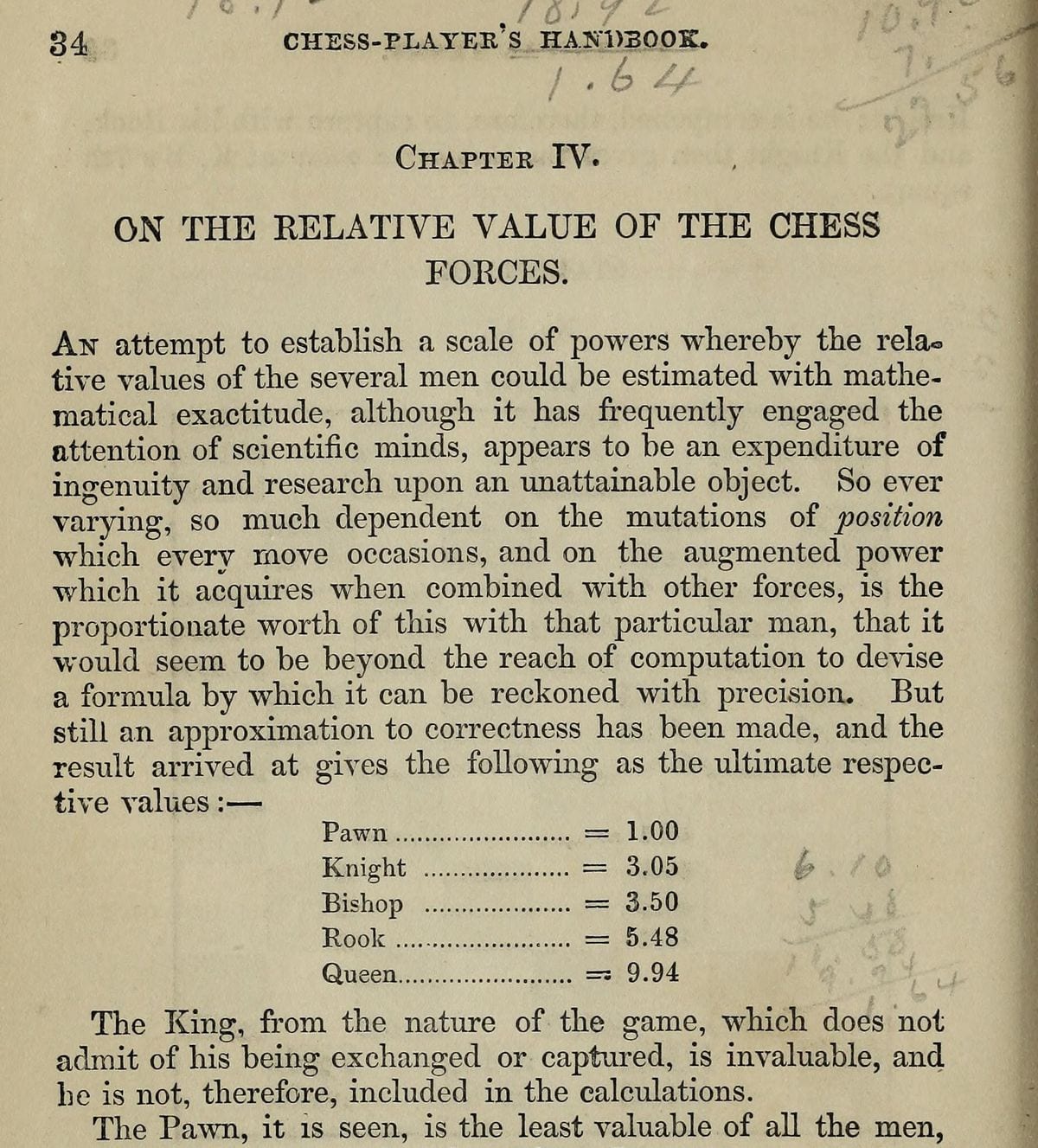
| Staunton, Chess-Player’s Handbook (1847) | 1.00 | 3.05 | 3.50 | 5.48 | 9.94 | King “invaluable,” left out. Rook = minor piece + 2 pawns |
| Fine, Chess the Easy Way (1942), as quoted by Edward Winter | 1 | 3 | 3 | 5 | 9 | The round-number scale taught to beginners |
| Kaufman, Evaluation of Material Imbalances (1999, per Tomašev et al.) | 1 | 3.25 | 3.25 | 5 | 9.75 | Bishop pair +0.5. Exchange averages 1¾ pawns |
| AlphaZero, Tomašev et al. (2020), classical rules | 1 | 3.05 | 3.33 | 5.63 | 9.5 | Fitted to self-play results, piece counts only |
Stockfish 19 constants (types.h) | 1 (208) | 3.75 (781) | 3.97 (825) | 6.13 (1276) | 12.20 (2538) | Internal search units, not a teaching scale |
Capablanca isn’t in the table because he refused to write one. In Chess Fundamentals (1921) he says there is no complete and accurate table, and that the only thing to do is compare the pieces separately. His comparisons are still the clearest: a rook is worth a knight and two pawns, or a bishop and two pawns, and two bishops are almost always better than two knights.
Strip out Stockfish and the four published scales sit within a narrow band across 173 years. The knight runs from 3.00 to 3.25, the bishop from 3.00 to 3.50, the rook from 5.00 to 5.63 and the queen from 9.00 to 9.94. One coincidence is worth a second look: AlphaZero’s learned knight value, 3.05, is the same figure Staunton printed in 1847. The Stockfish row looks off only because its pawn constant (208) is a search unit and not a point. Divide through and the queen comes out at 12.2 pawns, a number the engine uses to order captures and prune lines, not to teach anyone.
Where did 1-3-3-5-9 come from?
Not from Staunton. His table has decimals, his chapter opens by calling the whole attempt an “unattainable object,” and it closes with a warning: the worth of a piece shifts so much with time, opportunity and position that only experience can say which to give up and which to keep.
Winter’s Chess Notes quotes the chess historian Robert John McCrary tracing Staunton’s figures back to an 1817 edition of Philidor’s analysis, where Peter Pratt apparently devoted 40 pages of mathematics to a scale ending in queen 9.94, rook 5.48, bishop 3.5, knight 3.05, pawn 1. Winter also notes that Charles Tomlinson printed the same scale in Amusements in Chess in 1845, two years before Staunton did.
The round version arrived later. McCrary credits Reuben Fine’s 1942 Chess the Easy Way, which set pawn 1, bishop or knight 3, rook 5, queen 9 and described the table as satisfactory for rough calculation. McCrary adds that by the 1930s great players such as Capablanca and Tarrasch were avoiding a single scale and judging exchanges one at a time. On his account, the 1-3-3-5-9 that beginners memorize is a twentieth-century simplification of a nineteenth-century scale.
Why does the king have no point value?
Because you never trade it. Staunton puts it in one sentence: the king can’t be exchanged or captured, so he is invaluable and is left out of the calculations. Stockfish’s source code agrees. Its piece-value array assigns the king a value of zero.
That doesn’t make the king weak. Capablanca calls the king a purely defensive piece in the middlegame that turns offensive once the pieces come off, and handling it becomes of paramount importance in the endgame. A king that marches to the center and picks off pawns is fighting like any other piece, with no point value to show for it. The scale measures what you can swap, and the one piece you can’t swap is the one that ends the game.
Is a bishop worth more than a knight?
Usually the same, until you own both bishops. Kaufman ran about 300,000 games between players rated 2300 or higher and found that an unpaired bishop and an unpaired knight were equal to within a fiftieth of a pawn. The bishop’s higher average in his data comes entirely from the bishop pair, which he values at half a pawn on average. That bonus is smaller than half a pawn with most pawns still on the board and larger once half of them are gone.
Capablanca saw the same thing from the other direction. For general purposes, he says, treat the two as equal, though he thinks the bishop is the better piece in most cases and that two bishops almost always beat two knights. He also gives the bishop an edge against pawns and against a rook, and Kaufman’s numbers back both claims.
Why is the pair worth so much? Kaufman’s explanation is redundancy. Two knights, two rooks, or a bishop and knight can guard the same squares, so some of their work overlaps. Two bishops on opposite colors can’t overlap at all.
When does the knight win? With six or more pawns each on the board, Kaufman found the knight holding a very slim edge. With four or fewer pawns each, the bishop leads by about an eighth of a pawn. The knight is the piece that loses value as the board opens up.
How much is the exchange worth?
The exchange means giving a rook for a bishop or knight. On the 5-minus-3 arithmetic it’s 2 pawns, and Kaufman’s data puts the average at 1¾. He notes that most authors use 2, that Tarrasch, Mednis and Larry Evans used 1½, and that Tigran Petrosian claimed the exchange was worth only one pawn.
The bishop pair explains much of the disagreement. When the side down the exchange holds both bishops, Kaufman’s data says it needs only 1.15 pawns of compensation to make things even.
Two more factors move the number. More major pieces on the board favor the minor piece: with no minor pieces traded, the exchange drops to 1½ pawns. More pawns on the board favor it too, because each pawn trade helps the rook, and the knight’s edge grows to about half a pawn at five pawns against seven. Rooks need open files.
Two practical rules fall out of it. Holding a rook for a knight and two pawns, Kaufman says to try hard to trade the major pieces, against the usual rule that the side ahead should seek exchanges. Holding the minor pieces, keep the rooks and queens on and the pawns locked.
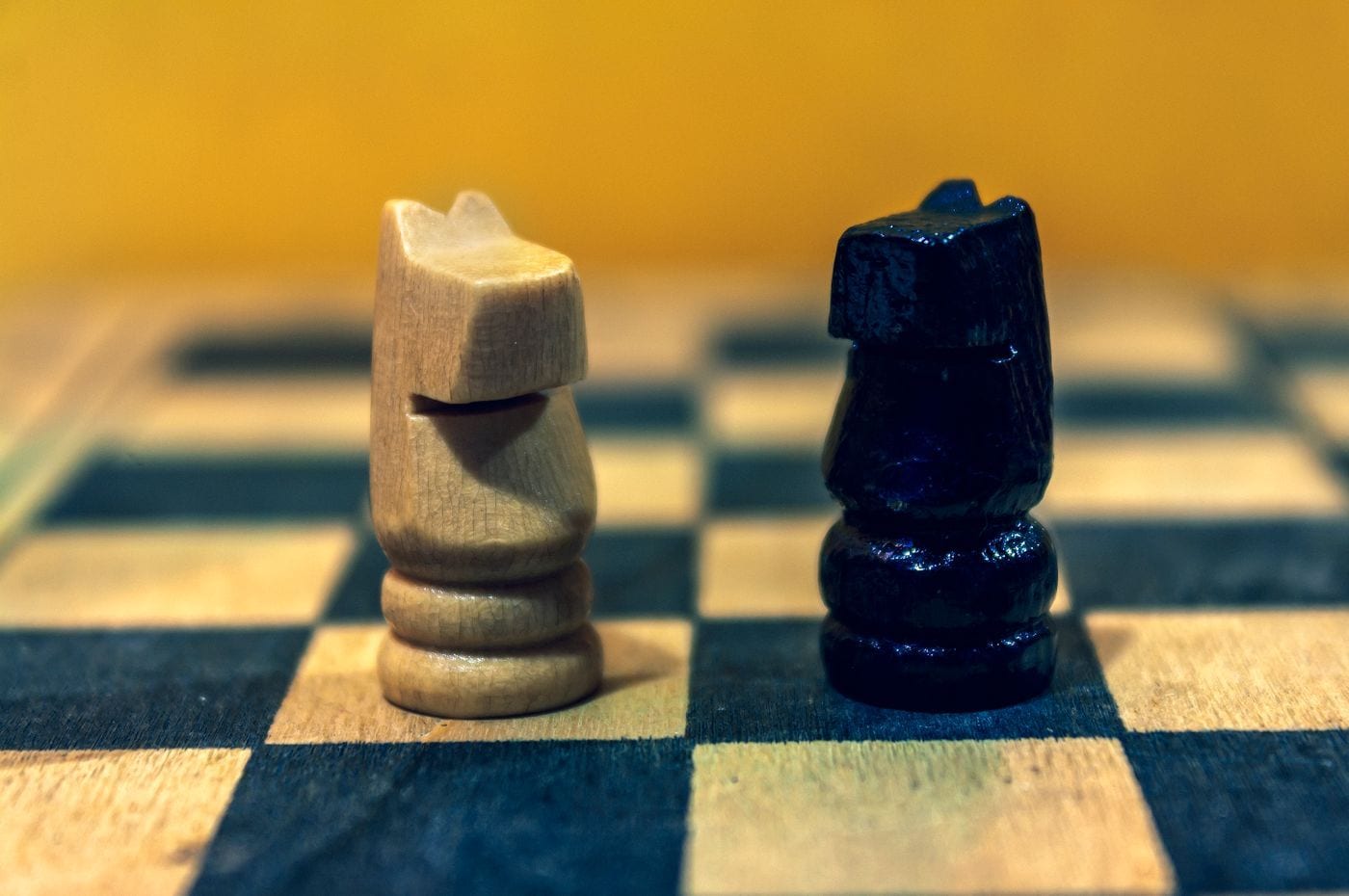
When do piece values break down?
Three situations account for most of the damage.
Pawn structure and open lines. Rooks gain value as pawns come off because they need open files. Kaufman suggests raising the knight by one sixteenth of a pawn and lowering the rook by one eighth for each pawn above five, which he calls too complicated for practical play but fit for a computer program. Capablanca puts the same idea in a line: a piece’s value can often be measured by the squares it commands, so a bishop hemmed in by its own pawns is worth less than the number says.
Endgames with the wrong piece. In Capablanca’s Example 30 White is a bishop and a pawn ahead and still can’t win, because a rook’s pawn that queens on the opposite color, with the enemy king in front of it, leaves the bishop absolutely worthless in his words. He also points out that two knights alone can’t mate unless the defender still has a pawn. Without one, the attacker can only stalemate, which is how material that looks decisive turns into a stalemate and a draw.
Queens and the big trades. Kaufman puts a queen at a rook, a minor piece and 1½ pawns when the other side lacks the bishop pair. He cites Garry Kasparov for the other half: the side without the queen needs the bishop pair to claim equality.
Even the engines hedge. The AlphaZero paper that produced the 3.05, 3.33, 5.63 and 9.5 line warns that piece values vary with positional considerations and game stage and shouldn’t be taken as a gold standard. Stockfish takes the lesson further. Its evaluation comes from a neural network, and the constants in types.h feed capture ordering, exchange checks, pruning margins and a material term that scales the network’s output.
How should you use the numbers over the board?
Count before every trade, then correct the count. Start with 1-3-3-5-9. Add half a pawn if you hold both bishops. Take a little off a rook when the position is closed. Then ask what the pieces can reach, because the pieces that reach more squares win the arguments the table can’t settle. Chess tactics is where the table gets overruled outright: a queen sacrifice is the plainest case of paying nine points to win the game.
If you’re still building the habit, start with chess strategy for beginners, then look at how rating bands change what you should trust. For imbalances in practice, Silman’s How to Reassess Your Chess is subtitled “Chess Mastery Through Chess Imbalances,” and endgames are where the 1-3-3-5-9 count stops working, which makes his Complete Endgame Course the natural second book. The best chess endgame books page covers the rest of that shelf. For the players who tested these numbers hardest, read the greatest chess players of all time.
Sources
- Staunton, Howard. The Chess-Player’s Handbook. London: Henry G. Bohn, 1847. Chapter IV, pp. 34-35. The page image above is the 1848 printing.
- Capablanca, José Raúl. Chess Fundamentals. New York: Harcourt, Brace, 1921.
- Kaufman, Larry. The Evaluation of Material Imbalances. Read in the Chess.com copy; Tomašev et al. cite it as Chess Life, 1999.
- Tomašev, Paquet, Hassabis and Kramnik. Assessing Game Balance with AlphaZero. arXiv:2009.04374, 2020.
- Stockfish source code,
src/types.h, tag sf_19. - Winter, Edward. The Value of the Chess Pieces. Chess Notes.
Further reading
- How to Reassess Your Chess, Jeremy Silman A book built around material and positional imbalances, the subject of this article.
- Silman's Complete Endgame Course, Jeremy Silman Endgames are where the 1-3-3-5-9 count stops working, and this is Silman's course on them.