Stalemate in Chess: Rules and Why It's a Draw
Stalemate is an automatic draw: the player to move has no legal move and isn't in check. It has cost strong players full points in winning positions.
Stalemate happens when the player to move has no legal move anywhere on the board and their king is not in check. FIDE’s Laws of Chess settle the outcome without ambiguity, in Article 5.2.1: the game is immediately drawn. It doesn’t matter if that player is down a queen, two rooks, and every pawn on the board. If they can’t move and nobody is attacking their king, the result is a half point each, not a loss.
That single rule has decided championship games and tournament prize money. A player can build a completely winning position, an extra queen, a mating net, a king with nowhere left to hide, and still walk away with half a point if they let the losing side’s king run out of legal moves while it’s not in check. It happens at every level, from beginners smothering an enemy king with an over-eager queen, to U.S. and world champions who have watched a full point disappear in a single careless move.
What is stalemate?
A position is a stalemate when three things are true at once: it’s one player’s turn to move, that player’s king is not currently attacked by any enemy piece, and that player has no legal move available anywhere on the board, not with the king, not with a pawn, not with any other piece. All three conditions have to hold together. If the king is in check, the position is checkmate (no way out) or just an ordinary check (there is a way out), never stalemate. If the player has any legal move at all, even a terrible one that loses on the spot, it isn’t stalemate. They have to play it.
The “is stalemate a win or a draw” confusion usually comes from gut instinct rather than the rule itself. It feels wrong that a player who can’t move should escape with half a point, especially when they’re down a rook or more. But the Laws of Chess treat “no legal move, no check” as a dead position: neither side can make progress on that move, so the game stops there as a draw. That answer is a relatively recent convention. Stalemate was scored as a win for the stalemated player in parts of 17th and 18th century England, and as an outright win for the player who delivered it in shatranj, chess’s medieval Persian and Arab ancestor. The draw-by-default rule now used worldwide only became standard as French and Italian practice spread across Europe.
The clearest real-world illustration is Larry Evans against Samuel Reshevsky, U.S. Championship 1963-64, round 9. Reshevsky was up a full knight in the endgame and, in Evans’s own words afterward, could “win as he pleases.” Instead of resigning, Evans played on with 47.h4, and Reshevsky answered with the natural-looking 48…Qxg3, grabbing a second pawn rather than the safer 48…Qg6. That one move let Evans force 49.Qg8+ Kxg8 50.Rxg7+, and both players agreed to a draw on the spot: capturing the rook leaves Black’s king on g8 with no legal move and no check, an immediate stalemate, while declining the capture lets White’s rook check forever along the seventh rank. Chess writers still call it the Swindle of the Century. Reshevsky’s extra knight, and the full point that should have come with it, disappeared in three moves.
Evans White Reshevsky Black


How stalemate works
Every legal move gets checked against the same three conditions: whose turn is it, is that player’s king currently attacked, and does that player have at least one legal move anywhere on the board. If the king isn’t attacked and there is no legal move, the position is a stalemate and the game ends immediately as a draw. The move that produces the stalemate has to be legal in its own right; a move that would leave your own king in check is illegal and can’t be played at all, so it can’t create a legal stalemate either.
What actually causes stalemate at the board is almost always over-restriction. The winning side keeps advancing a queen or a king to squeeze the losing side’s king, and takes away its last remaining square without noticing that the final move doesn’t give check. A king boxed into a corner by its own pawns, and a lone king facing a queen that has crept one square too close, are the two patterns behind the overwhelming majority of real stalemates. If you’re the side that’s already lost and looking for a way out, the technique runs the other direction on purpose: strip yourself down toward a bare king, sometimes by deliberately sacrificing your last pieces (a “desperado,” in chess slang), and steer for a position where your opponent’s remaining material covers every square around your king but never actually gives check. That is exactly what Evans did on move 47. It’s a repeatable defensive resource, not a fluke, and it’s the main practical answer to “how to force a stalemate”: count how many escape squares the defending king has left, then look for a forcing sequence that removes the last one without ever delivering check.
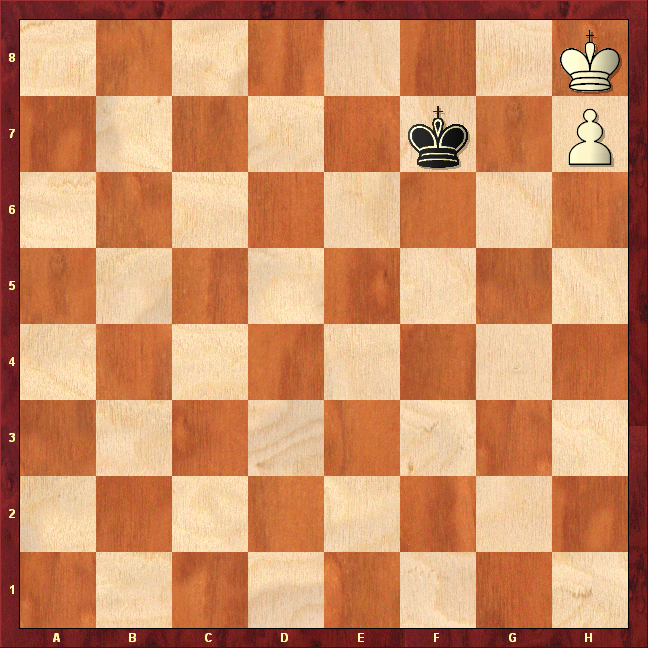
The distinction from checkmate comes down to a single word: check. Checkmate is “no legal move, and currently in check,” a loss for the checkmated side. Stalemate is “no legal move, and not in check,” a draw. Same paralysis, opposite king status, completely different result. A king cornered on h8 with a queen delivering check from g7 is dead. The same king with the same queen sitting on g6 instead, giving no check but covering every escape square, is stalemated, and the game is drawn. Players who blur the two either resign positions that were actually drawn, or celebrate wins that were actually draws, until someone points at the position on the board.
Stalemate in practice
Evans-Reshevsky is famous because the losing side engineered it on purpose. Other well-documented games show the opposite: a player who was genuinely ahead let stalemate happen almost by accident, or reached for it deliberately because there was no other way to save a difficult position.
Game 5 of the 1978 World Chess Championship, Viktor Korchnoi against defending champion Anatoly Karpov in Baguio City, ran 124 moves, a king-and-bishop-versus-king-and-pawn ending both men recognized as a theoretical draw long before it actually ended. The match was notoriously bitter (the two were not speaking away from the board), so neither would simply offer a draw and end it early. Korchnoi later said it gave him real satisfaction to instead maneuver his bishop to g7 on move 124 and stalemate the reigning world champion outright, rather than let a drawn position peter out any other way. Same rule as Evans-Reshevsky, same outcome, this time used as a deliberate statement rather than a swindle.
Even elite players walk right up to the edge of stalemating themselves out of a win without meaning to. In Ossip Bernstein against Vasily Smyslov, 1946, Smyslov had to see three moves ahead in a rook endgame to avoid it. After 59…b2 60.Rxb2, the tempting 60…Rh2+ 61.Kf3 Rxb2 looks like it wins White’s last pawn outright, until you notice Black’s own king and rook have nowhere else to go afterward: an immediate stalemate. Smyslov played 60…Kg4 instead, and the game was drawn cleanly a move later, without either side losing the point they’d earned. The lesson generalizes past this one game: any time a forced sequence ends with your opponent’s king boxed in, stop and count its legal moves in the final position, not just whether you’re ahead on material going in.
What to look for in your own games: any endgame where you have overwhelming material and your opponent’s king is running out of board. Before playing what looks like the winning move, ask one question: after this move, can the opposing king go anywhere, and is it in check? If the answer to both is no, you haven’t won. You’ve drawn. Checking that question on every move of a won endgame, not just the ones that feel dangerous, is what eliminates almost all accidental stalemates.
Common mistakes
Rushing the queen in a king-and-queen-versus-king ending. A queen is powerful enough to smother a lone king without ever giving check. Walking the queen to a square a knight’s move away from the enemy king, rather than a king’s move away, is the single most common stalemate blunder in chess. It happens to players at every rating because the correct technique, drive the king to the edge using checks and your own king’s support, never a close move that isn’t check, is a trained habit rather than an instinct.
Pushing the last pawn through to promotion without checking king safety first. In king-and-pawn endings, the move right before a pawn queens is often the most dangerous moment in the position for the side that’s winning. A defending king with only one or two legal squares left can be stalemated by the promotion itself, by a “check” that turns out not to be check because of a pin or a blocked line, or by a supporting king move that quietly removes the defender’s last escape square. Count the defender’s legal moves before playing the move that looks decisive, not after.
Assuming material advantage guarantees the result. “I’m up a rook, I can’t lose” is exactly the thinking that has cost strong players full points, Reshevsky included. Stalemate doesn’t care about the score on the board. It cares about exactly one thing: does the player to move have a legal move. A position that looks completely lost for the side that’s actually losing isn’t lost until it’s checkmated or the clock runs out. Stalemate is available at any material deficit, all the way down to a bare king against a full army.
How to improve at avoiding (and using) stalemate
The fix for accidental stalemates isn’t deeper calculation. It’s a checklist habit: before playing any move in a winning endgame, ask whether the opposing king will still have a legal move afterward, and whether that move gives check. Drilling king-and-pawn and king-and-queen endgame technique until that check runs automatically is what separates players who convert winning endgames cleanly from players who occasionally hand half a point back for free.
For the most direct path to that technique, Silman’s Complete Endgame Course (affiliate) groups its lessons by rating level, so a player working through basic king-and-pawn endgames studies only the chapters written for that level, the ones that drill the “always leave the king a square” habit until it stops requiring conscious thought.
Also see: chess notation for reading the games discussed here move by move, pawn promotion for the exact moment most king-and-pawn stalemates happen, chess tactics for the calculation skills that catch a stalemate trap before you walk into it, and how to improve at chess for a broader study plan.
Sources
- FIDE Laws of Chess, Article 5 (The Completion of the Game)
- Wikipedia, “Stalemate”
- Wikipedia, “Swindle (chess)”
- Evans, Larry, vs Samuel Reshevsky. U.S. Championship 1963-64, Round 9.
- Silman, Jeremy. Silman’s Complete Endgame Course. Siles Press. (affiliate)
This page contains affiliate links. As an Amazon Associate, DiscussChess earns from qualifying purchases.
Sources
Further reading
- Silman's Complete Endgame Course, Jeremy Silman ASIN verified via Open Library 2026-07-12. Organized by rating band, so the early chapters drill exactly the king-and-pawn and king-and-queen technique that prevents accidental stalemates, without wading into master-level material.