Best Chess Endgame Books by Rating Level
Silman's Complete Endgame Course is the right starting point for most players. 100 Endgames You Must Know is the right second book. What comes after those two depends on your level. A guide to endgame literature organized by when to read it.
Most chess players know their endgame is weak before they get to the endgame. The position simplifies, the pieces come off, and they realize they have no idea what to do next. Endgame books are the fix, but only if you read the right one at the right stage.
Start with Silman’s Complete Endgame Course. If you’ve already worked through that, the next book depends on where you are.
This is also the higher-leverage place to spend your study time if you’re under 1600. Most club games don’t end in the opening: they end in the endgame, decided by technique or the absence of it. Opening study returns much less at that level than the same hours spent learning to convert a won rook ending or hold a drawn one.
For players under 1400: Silman’s Complete Endgame Course
Silman’s Complete Endgame Course by Jeremy Silman (Siles Press, 2007)
The reason this book works where others don’t: it tells you what to ignore. Silman organized endgame knowledge by rating level, the 1000-section covers what a 1000-rated player needs, the 1400-section covers what a 1400-rated player needs, and so on up to master level. You read the section above your current rating. You stop there.
Most endgame books don’t do this. They present everything comprehensively (queen-versus-rook endings, rook-and-bishop versus rook, specific pawn structures) in a sequence that buries beginners in material they can’t use for years. Silman’s structure respects that a club beginner and a 2000-rated expert need completely different things.
For players under 1400, the relevant content covers king-and-pawn endings, basic rook endings, and the concept of zugzwang. These three areas cover the endgames you’ll actually reach in rated games. Master them before reading further in the book.
Buy Silman’s Complete Endgame Course on Amazon (affiliate)For players 1200–1600: 100 Endgames You Must Know
100 Endgames You Must Know by Jesús de la Villa (New in Chess, multiple editions)
De la Villa’s book covers exactly what the title says: 100 endgame positions that appear repeatedly in practical games and that every serious club player needs to know cold. The selection is well-curated. He’s not trying to be comprehensive: he’s trying to give you the positions that actually matter.
The 100 positions include the Lucena (rook-plus-pawn-on-seventh versus rook, how to win it), the Philidor (the defending drawing method in rook endings), the opposition and key squares in king-and-pawn endings, the queen-versus-pawn-on-seventh maneuver that wins positions most players give up, and the key rook-and-pawn positions that determine whether certain endings are won or drawn.
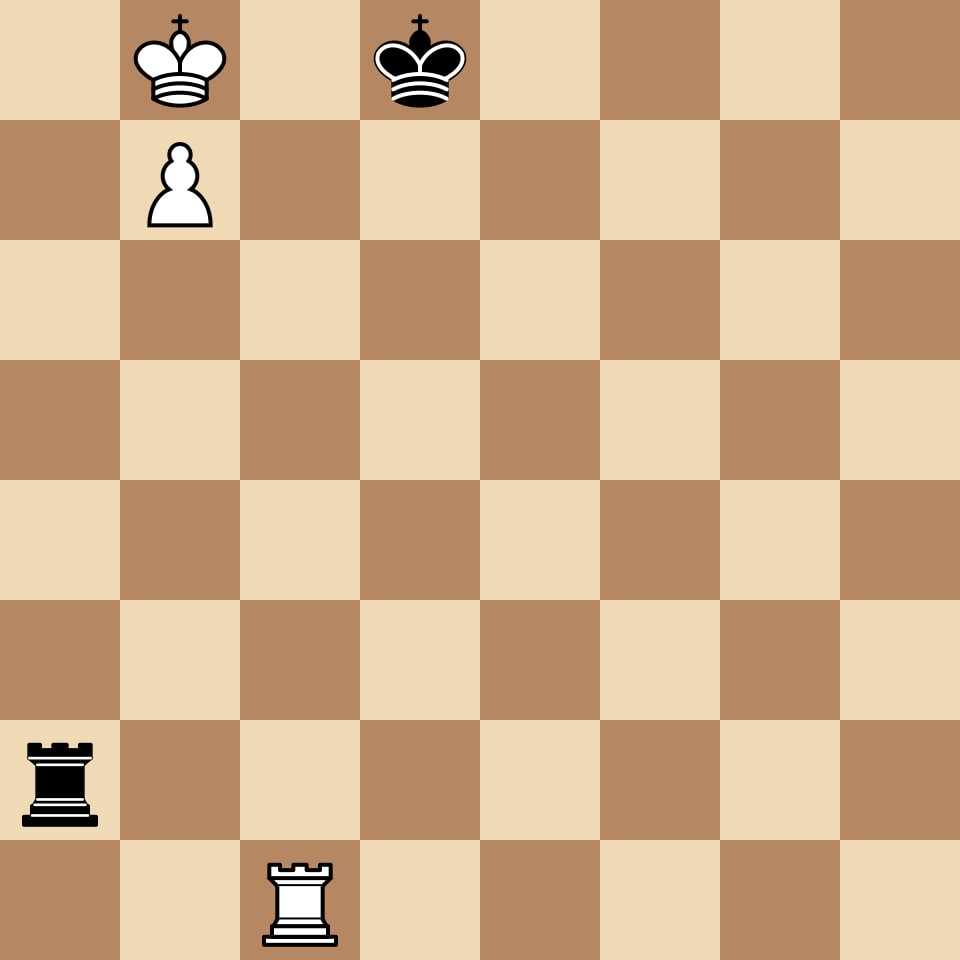
The Lucena and Philidor deserve a beat of their own since they come up constantly in practical games. In the Lucena, the attacking side has a rook and a pawn on the seventh rank against a lone rook, with the defending king cut off from the pawn. The win comes from a technique called building a bridge: the attacking rook shields its own king from checks so the pawn can queen. In the Philidor, the roles are reversed and it’s the defender’s job. Keep the rook on the third rank in front of the pawn until it advances, then swing behind it to check the enemy king from a distance. Play it correctly and it’s a dead draw. Miss the idea and a drawn position quietly becomes a loss.
The explanations are clear and the positions are well-chosen. If you work through this alongside Silman’s book, you’ll cover the essential endgame material for club play entirely.
Buy 100 Endgames You Must Know on Amazon (affiliate)For free: Chess Fundamentals by Capablanca
Chess Fundamentals by José Raúl Capablanca (1921): available free from Project Gutenberg
Capablanca was World Champion from 1921 to 1927 and wrote this book as a general chess instruction text. The endgame sections are extraordinary. His understanding of king-and-pawn endings was widely considered the best of any player in the 1920s, and the explanations in the book reflect that.
The language is period English and some opening recommendations are a century out of date. Skip the opening sections. The endgame and strategic content, particularly the chapters on king activity and pawn endings, remain among the clearest available at no cost.
Search “Chess Fundamentals Capablanca Project Gutenberg” for the free download. No affiliate link: it’s public domain.
For players 1600+: what comes next
Above 1600, the general endgame books have done most of their work. What remains are specific theoretical areas that matter at the next level:
Rook endings in depth. Rook endings are the most common practical endgame type, and they’re also the type where theoretical knowledge extends furthest. At 1600+, the Lucena and Philidor are not enough. You need the Cochrane Defense, Karstedt’s position, the rule of the square in specific configurations, and other positions that appear in tournament play at club-strong levels. De la Villa covers this partially; for deeper coverage, look for books specifically on rook endings. Verify current ASINs before purchasing.
Dvoretsky’s Endgame Manual (Russell Enterprises, 2014) is the standard reference for serious competitive players. It’s not for beginners. The problems are hard, the analysis is dense, and the expected reader is roughly 2000+ rated. Multiple printings exist, the 424-page Russell Enterprises edition (ASIN 1941270042) is the standard.
For the sequence of study that puts endgame work in context, see our chess study plan and chess improvement guide. For books at other levels, see our best chess books for beginners.
This page participates in the Amazon Associates program (tag: discusschess-20). ASINs verified before publishing.
This page contains affiliate links. As an Amazon Associate, DiscussChess earns from qualifying purchases.
Sources
- Silman, Jeremy. Silman's Complete Endgame Course. Siles Press, 2007.
- de la Villa, Jesús. 100 Endgames You Must Know. New in Chess, multiple editions.
- Capablanca, José Raúl. Chess Fundamentals. Harcourt Brace, 1921. (Public domain.)
Further reading
- Silman's Complete Endgame Course, Jeremy Silman, Siles Press, 2007 ASIN verified via Open Library 2026-05-02. Organized by rating level. Buy this first.
- 100 Endgames You Must Know, Jesús de la Villa, New in Chess ASIN verified via Amazon inline reference. The 100 positions with clear winning/drawing methods.
- Dvoretsky's Endgame Manual, Mark Dvoretsky, Russell Enterprises, 2014 ASIN verified via Open Library 2026-05-02. 424-page standard edition. The reference text for 2000+ rated players. Not for beginners.