Four Knights Game: Main Lines and Gambits
The Four Knights (1.e4 e5 2.Nf3 Nc6 3.Nc3 Nf6) is the most symmetrical opening in the Open Games. Spanish, Scotch, Rubinstein's 4...Nd4 and the Halloween Gambit, plus where the drawish reputation is actually earned.
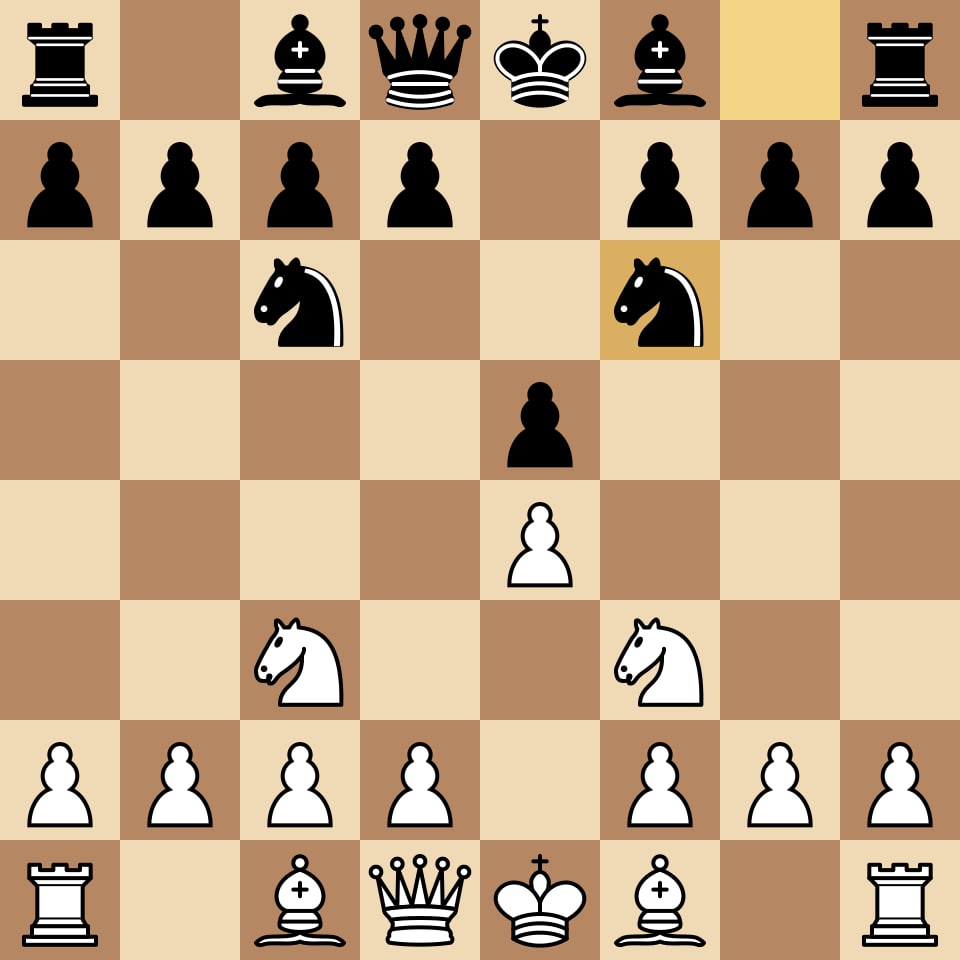
The Four Knights Game is 1.e4 e5 2.Nf3 Nc6 3.Nc3 Nf6, the position where both sides have developed both knights and nothing else. It carries ECO codes C47 to C49 and a reputation for being dry, which comes almost entirely from one line: the Symmetrical Variation, where Black copies White’s moves and the game simplifies fast. The other branches are not dry at all, and one of them involves sacrificing a knight on move four.
That reputation is worth taking seriously rather than dismissing. It is deserved in the specific place it was earned and misapplied nearly everywhere else.
What is the Four Knights Game?
It is what happens when both players follow the oldest piece of opening advice there is. Develop knights before bishops, control the centre, do not move the same piece twice. Follow that literally as White and you get 2.Nf3 and 3.Nc3. Follow it literally as Black and you get 2…Nc6 and 3…Nf6. Nobody has done anything wrong, and the position is a mirror.
That symmetry is the source of everything, good and bad. White is a tempo up in an identical position, which is worth something but not much, because there is no target to aim the tempo at. No pawn is loose. No piece is misplaced. White’s fourth move has to actually generate an imbalance from scratch, and there are five reasonable ways to try.
The opening was a main line in the 19th century, when the Open Games were the whole of top-level theory. It faded by the First World War as the Ruy Lopez took over, and came back in the 1990s, when grandmasters including Nigel Short, Michael Adams and Alexei Shirov started using it again as a way to reach fresh middlegames instead of walking into somebody’s Spanish preparation.
Why does the Four Knights have a dull reputation?
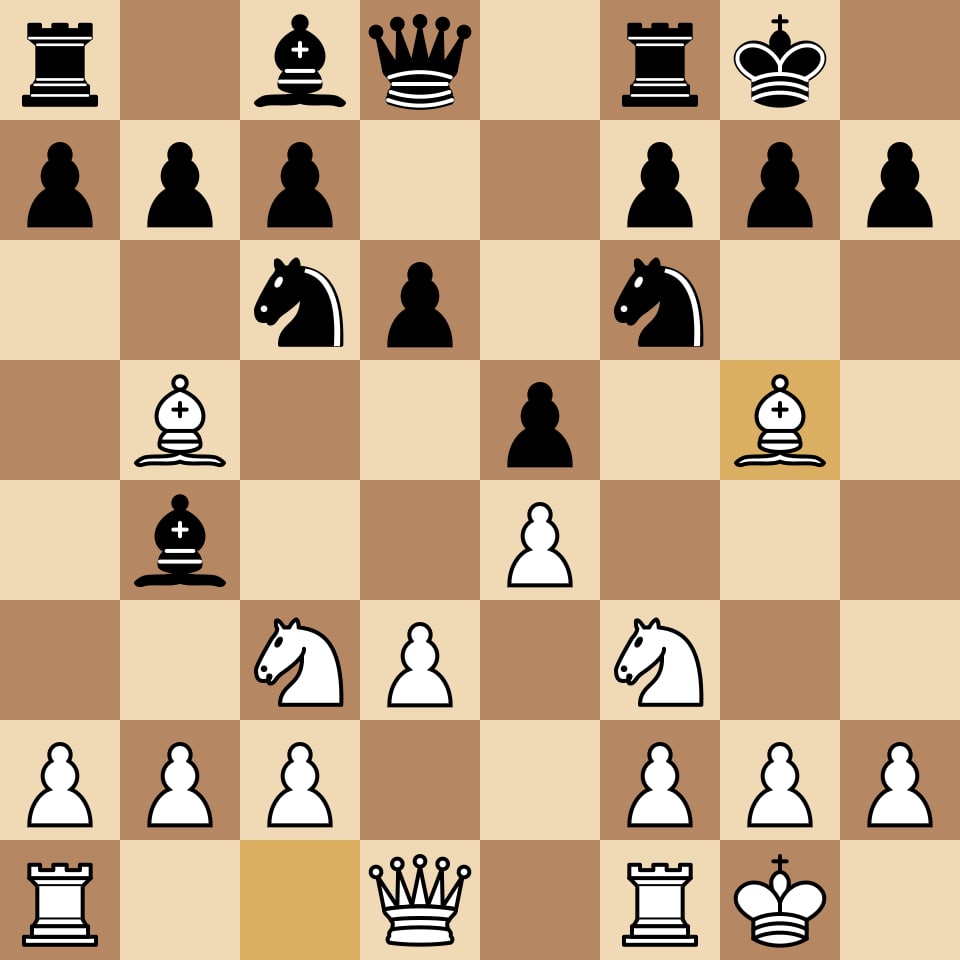
The Spanish Four Knights runs 4.Bb5, and if Black answers 4…Bb4 the mirroring continues: 5.O-O O-O 6.d3 d6 and now 7.Bg5. Somebody has to move first, and White does, pinning the f6 knight.
Black unpins with 7…Bxc3 8.bxc3 Qe7, called the Metger Unpin. The queen steps off the d8 to h4 diagonal so the pin is gone, and the knight on c6 usually reroutes to e6 through d8 to challenge the bishop on g5. White has the bishop pair and doubled c-pawns. Black has a sound structure and slightly less space. Both sides know exactly what they are doing.
Here is the honest problem with it: the position is balanced, the plans are slow, and there is no lever that forces either side to take a risk. A draw is a perfectly natural result between equally matched players who both know the theory, and that has been true since roughly 1900. If you play the Symmetrical Variation and both of you are content with a draw, you will get one. That is not a slander on the opening, it is a description of it.
What the reputation gets wrong is scope. It attached itself to the whole Four Knights and stayed there for a century.
What did Rubinstein do about it?
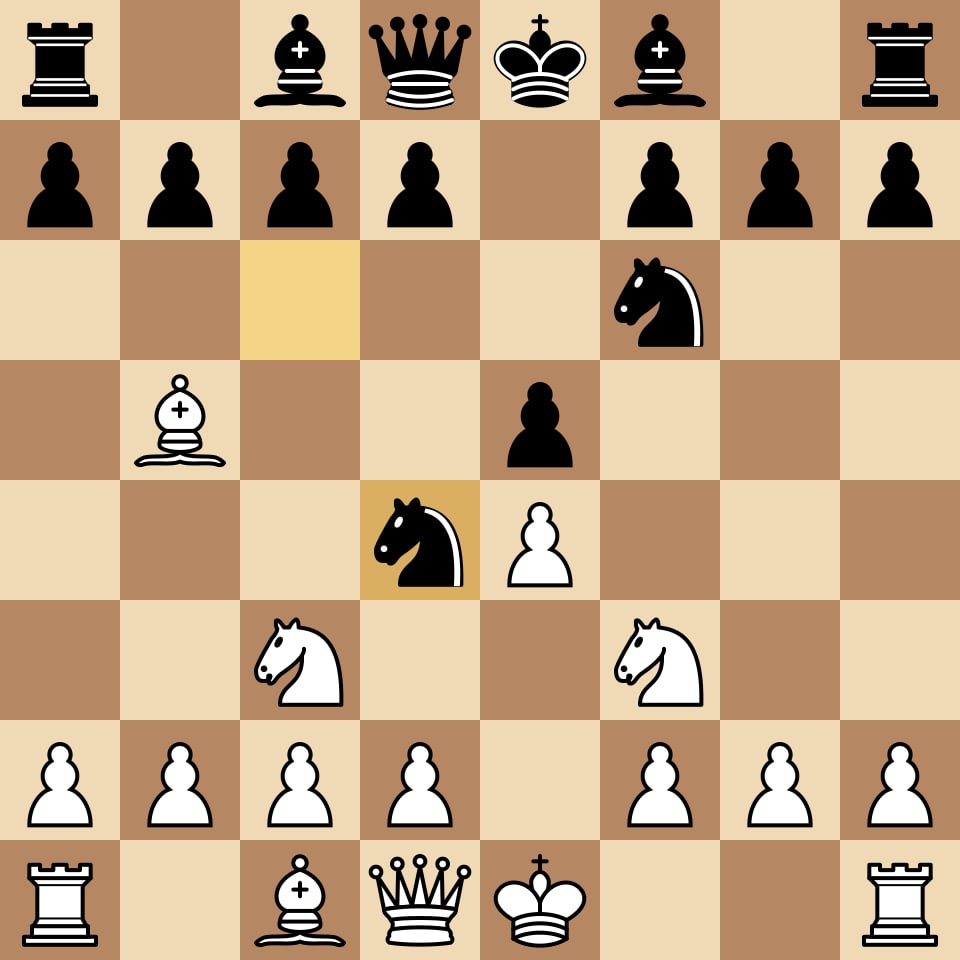
Akiba Rubinstein’s answer to the mirror was to stop looking in it. After 4.Bb5, he played 4…Nd4, which attacks the bishop, ignores the threat to c6, and dangles the e5 pawn as bait. White has four serious tries: 5.Ba4 and 5.Bc4 keep the bishop, 5.Nxd4 exd4 6.e5 heads for a simplified position, and 5.Nxe5 grabs the pawn and runs into 5…Qe7, which regains the material with the bishop pair thrown in.
Rubinstein did not use it once as a novelty. In the PGN Mentor collection of his games, 4…Nd4 appears fourteen times between 1912 and 1930, against Spielmann, Nimzowitsch, Bogoljubow, Maroczy and Bernstein among others. He treated it as a system, and the theoretical result was that White’s most natural fourth move stopped guaranteeing anything.
The 1925 game against Rudolf Spielmann at Baden-Baden is the one to watch, because of where White’s king ends up.
Spielmann, Rudolf White Rubinstein, Akiba Black


Ten moves out of the Four Knights and White’s king is on g3 with a black knight sitting on g4. Whatever else that is, it is not quiet.
What is the Scotch Four Knights?
The other principled fourth move is 4.d4, hitting the centre immediately instead of the c6 knight. After 4…exd4 5.Nxd4 Bb4 6.Nxc6 bxc6 7.Bd3 d5 8.exd5 cxd5, Black has an isolated-ish centre and free piece play, White has a clean structure, and the position has actual content in it.
It also has a famous outing. Game 5 of the 1996 Deep Blue versus Kasparov match in Philadelphia was a Four Knights by transposition, reaching this exact structure. Kasparov won that game with Black, and the match 4-2, a year before the rematch went the other way.
Inside 4.d4 there is also the Belgrade Gambit: 4…exd4 5.Nd5, offering a pawn to plant a knight on the fifth rank. Black has several sound answers, including 5…Be7, 5…Nb4 and 5…Nxe4, so this is not a refutation of anything. It is a way to get a sharp position against an opponent who came to the board expecting a handshake.
What about 4.Bc4 and 4.g3?
Two more fourth moves, and one of them is a trap for White rather than Black.
4.Bc4 looks like the most natural developing move on the board and it walks into 4…Nxe4, the fork trick. White cannot simply take the knight, because 5.Nxe4 d5 forks bishop and knight and Black regains the piece with a good game. This costs club players games constantly, in both directions, and it is worth ten minutes with a board. The safe route to the same setup is the move order 1.e4 e5 2.Nf3 Nc6 3.Bc4 Bc5 4.Nc3 Nf6, which transposes into the Giuoco Pianissimo with the bishop already committed and the trick unavailable.
4.g3 is the Glek System, named for Igor Glek, and it is the quiet one that actually asks a question. White fianchettoes, keeps every pawn flexible, and plays for a slow squeeze rather than a fight over e5. Black equalises with 4…Bc5 or 4…d5, which is the honest theoretical verdict, but equalising and knowing what to do next are different problems, and the Glek reliably produces the second one.
Is the Halloween Gambit sound?
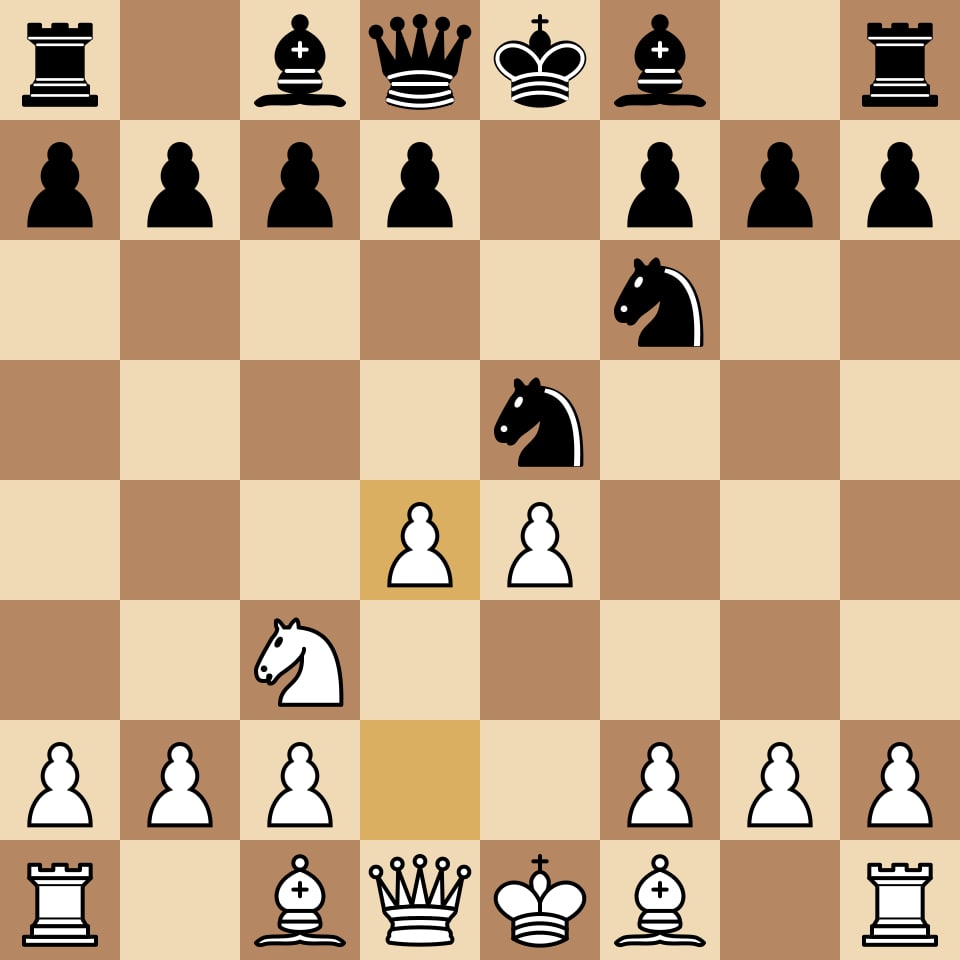
No. 4.Nxe5 Nxe5 5.d4 gives up a knight for a pawn on the theory that the pawn duo on d4 and e4 will drive Black’s pieces back to the first rank and White’s development will be worth more than the material. After 5…Ng6 6.e5 Ng8 7.Bc4, Black’s kingside knight really has been chased home, which is the gambit at its most persuasive.
Then Max Euwe published the answer: 7…d5 8.Bxd5 c6, hitting the bishop and untangling, and Black comes out a piece ahead with a decisive advantage. That assessment has not been overturned.
Which does not mean it never scores. A club opponent facing it for the first time, on a clock, has to find a specific sequence while a piece up and under attack, and plenty of them do not. The gambit is a practical weapon and an unsound opening at the same time, and those two facts sit together fine as long as you know which one you are relying on.
Where the reputation is earned, and where it is not
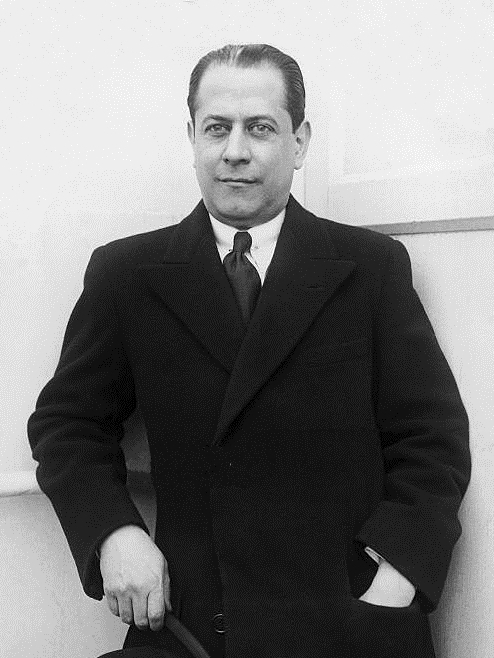
The most famous Four Knights in the literature is Capablanca against Herman Steiner, played on 11 April 1933 at the Los Angeles Athletic Club with living pieces in costume, refereed by the film director Cecil B. DeMille. It goes straight down the Symmetrical Variation, and on move 17 Capablanca plays Rxf6, dragging the black king from f7 to c5 and mating on move 25.
It is spectacular and it appears in dozens of anthologies. It is also, according to Steiner himself, not a real game. Writing in Chess Review in March 1943, he said it “was pre-arranged by Capablanca, who at that time refused to play any other way”, and added that he wanted this known because it “could not possibly be considered an Immortal Game”. The chess historian Edward Winter has documented the whole episode. So the single best advertisement for the Four Knights being exciting is a game that was probably choreographed, which tells you something about how the reputation formed.
The real answer is narrower and more useful. The Symmetrical Variation with 4…Bb4 does trend drawish, at every level, and always has. Nothing else in the opening does. The Rubinstein Variation produces unbalanced fights, the Scotch Four Knights produces a normal middlegame with structure to play against, the Belgrade Gambit produces chaos, and the Glek System with 4.g3 produces a slow squeeze that nobody has solved. Blaming all of that for what happens after 4…Bb4 is like calling the Sicilian sharp on the strength of the Najdorf and expecting the same from the Alapin.
Is it worth playing at club level?
Yes, for a specific and slightly unglamorous reason: you will almost never face preparation in it. Most players who meet 1.e4 with 1…e5 have spent their study time on the Ruy Lopez and the Italian Game. Nobody arrives at a weekend tournament with twenty moves of Four Knights ready to go.
The other thing it gives you is a clean board on which to learn how development actually converts into an advantage, because there is nothing else going on. That is the same reason Logical Chess: Move by Move (affiliate) is still the standard first annotated game collection after seventy years. Chernev explains the purpose of every single move, and in an opening this bare, the purpose of every move is the whole game.
If you want to play it with real intent rather than as a resting position, pick 4.d4 or 4.g3 and skip the Symmetrical entirely. And if you are on the black side and someone plays 4.Bb5 at you, remember what Rubinstein did about it. Our chess openings guide sets out how these choices fit into a repertoire, and chess strategy for beginners covers the development principles the Four Knights is essentially a laboratory for.
Sources
- Wikipedia. “Four Knights Game.” ECO C47 to C49, Symmetrical Variation and the Metger Unpin, Rubinstein Variation, Scotch Four Knights, Belgrade Gambit, Glek System, Halloween Gambit and Euwe’s refutation line, popularity history and 1990s revival.
- Winter, Edward. “Capablanca v Steiner (Living Chess).” Chess Notes. Full game score, 11 April 1933, Los Angeles Athletic Club, Cecil B. DeMille as referee, and Steiner’s statement in Chess Review, March 1943, page 66.
- Rudolf Spielmann vs Akiba Rubinstein, Baden-Baden 1925, chessgames.com Game score, cross-checked against the Rubinstein collection at PGN Mentor, which also supplies the count of fourteen 4…Nd4 games between 1912 and 1930.
- PGN Mentor, Kasparov game collection. Deep Blue versus Kasparov, Philadelphia 1996, game 5, recorded as ECO C47 with Kasparov winning as Black.
- Chernev, Irving. Logical Chess: Move by Move. Batsford. (affiliate)
- Silman, Jeremy. How to Reassess Your Chess, 4th edition. Siles Press, 2010. (affiliate)
This page contains affiliate links. As an Amazon Associate, DiscussChess earns from qualifying purchases.
Sources
- Wikipedia. "Four Knights Game." (move order, ECO C47-C49, Spanish and Scotch variations, Belgrade and Halloween gambits, Glek system, popularity history)
- Winter, Edward. "Capablanca v Steiner (Living Chess)." Chess Notes. (game score, 11 April 1933 date, Los Angeles Athletic Club venue, Cecil B. DeMille as referee, and Steiner's pre-arrangement statement in Chess Review, March 1943, page 66)
- Rudolf Spielmann vs Akiba Rubinstein, Baden-Baden 1925 (game score)
- Deep Blue vs Garry Kasparov, ACM Chess Challenge, Philadelphia 1996, game 5 (Four Knights, ECO C47; game score cross-checked in the PGN Mentor Kasparov collection)
Further reading
- Logical Chess: Move by Move, Irving Chernev (Batsford) ASIN verified via Open Library 2026-08-07 (record returns Logical Chess, Move by Move, Irving Chernev, Batsford). Chernev annotates every move of 33 games built on exactly the development principles the Four Knights follows to the letter.
- How to Reassess Your Chess (4th ed.), Jeremy Silman (Siles Press, 2010) ASIN verified via Open Library 2026-08-07 (record returns How to reassess your chess, Jeremy Silman, Siles Press, 2010). The Symmetrical Four Knights turns on doubled c-pawns against the bishop pair, which is the imbalance Silman treats at greatest length.