En Passant: The Chess Rule Explained, With a Real Example
En passant lets a pawn capture an enemy pawn that just advanced two squares, but only on the very next move. The exact FIDE rule, where it came from, and the only recorded game it delivered checkmate in.
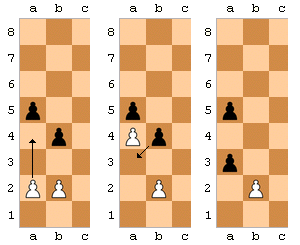
En passant is a special pawn capture. If an enemy pawn advances two squares on its very first move and lands directly beside one of your pawns, on the same rank, you may capture it as though it had moved only one square instead of two. The catch is timing: you can only do this on your immediate next move. Wait even one turn and the right disappears for good.
No rule in chess confuses more first-year players. It looks like a bug, or like a friend inventing a move to steal a pawn, because the capturing pawn doesn’t land on the square the enemy pawn is standing on. It lands on the square that pawn passed over. Online chess clients enforce en passant automatically and silently, which is exactly when the arguments start: “my pawn was never captured, it’s still right there,” three seconds before it visibly isn’t. Learning the rule properly, once, ends the argument for good.
What is en passant?
En passant, French for “in passing,” is defined in Article 3.7.3 of the FIDE Laws of Chess: a pawn occupying a square on the same rank as, and on an adjacent file to, an opponent’s pawn that has just advanced two squares from its starting square may capture that pawn as though it had moved only one square. The rule adds one hard constraint that beginners consistently miss: the capture is only legal on the move immediately following the two-square advance. Wait a move, and the opportunity is gone permanently for that pawn, even though the position on the board looks identical to a player seeing it cold.
The example most chess writers reach for is a diagram, not a real game, because en passant deciding anything outright is rare. There is exactly one documented case in chess literature of an en passant capture delivering checkmate, played in Melbourne over the 1928-29 Christmas holidays. It’s worth seeing in full further down this page.
How en passant works
Three conditions all have to be true at once. Your opponent’s pawn must still have been standing on its own starting rank (the second rank for White, the seventh for Black) the instant before it moved. It has to advance the full two squares in one move, not one. And it has to land on a square exactly beside one of your pawns, same rank, adjacent file. If all three hold, you may capture on your very next move, and only your very next move, no grace period and no “I’ll take it after I finish developing.”
The rule exists because of an earlier rule change. For most of chess’s history, a pawn could only ever move one square at a time, including its first move. Somewhere between the 13th and 16th centuries, European players started allowing a pawn’s first move to optionally cover two squares instead, a change that sped up openings considerably and is documented in the writings of the 16th-century Spanish priest and chess master Ruy López de Segura. That speed came with a side effect: a pawn could now dash straight past a square an enemy pawn was actively attacking, escaping a capture it would have walked directly into under the old one-square-only rule. En passant patches that hole. It lets the defending pawn capture exactly as if the two-square jump had never been offered, preserving the original tactical relationship between the two pawns for exactly one move. Some regions resisted the fix for centuries. Italy played a competing convention called passar battaglia and didn’t adopt standard en passant until 1880, ahead of the following year’s Milan tournament.
Notation doesn’t change for an en passant capture. It’s written exactly like any other pawn capture: the file the capturing pawn started on, an x, and the destination square. If a white pawn on e5 captures a black pawn that just advanced from d7 to d5, the move is written exd6, precisely the way exd6 would read against a pawn that had simply been sitting on d6 all along. Some players add “e.p.” as a courtesy note, exd6 e.p., but it isn’t required by the notation standard and leaving it off doesn’t affect the legality of the move.
Is en passant mandatory? No. FIDE’s Article 3.7.3.1 says a pawn “may” capture this way, the same permissive language the Laws use for every other capture in the game. A player is always free to decline a capture, en passant included, and play something else instead. The only widely-played chess variant where captures are forced is antichess, and that’s not the game running on your local club’s boards or on Lichess’s standard rating list.
The only en passant checkmate on record
Gunnar Gundersen faced A. H. Faul in the Christmas tournament held in Melbourne over the 1928-29 holiday season. The game opened as a French Defense, Advance Variation, and by move 9 Gundersen had thrown a bishop at Faul’s king with 9.Bxh7+, the “Greek gift” sacrifice, chasing the black king into the open. Faul’s king walked to g6, and four moves later to h6, hunted the whole way. Chess historian Edward Winter, who tracked down the original 1929 Melbourne newspaper report after decades of the players’ names being garbled in reprints (Gundersen frequently misspelled as “Gaudersen,” Faul as “Paul”), calls it the only game in chess literature that ended in an en passant capture administering checkmate.
Gundersen White Faul Black


The finish is precise, not lucky. 14.Nxe6+ isn’t check from the knight itself; it’s a discovered check, the knight stepping off g5 opens the long diagonal from White’s bishop on c1 straight through to Faul’s king on h6. Faul has exactly one way to block it, and only one: 14…g5, a pawn move that happens to be a two-square advance because that’s the only way a pawn starting on g7 can reach the blocking square in a single move. That forced two-square advance is what creates the en passant opportunity a move later. White’s h-pawn, already parked on h5 since move 13, captures the g-pawn en passant with 15.hxg6, and the single move does two things simultaneously: it removes the pawn that was blocking the discovered check, and it plants a white pawn on g6, closing off the last square next to Faul’s king. Checkmate, delivered by a pawn taking a pawn that, on the board a moment earlier, wasn’t even standing where the capture happened.
Common mistakes
Thinking the capture window stays open. By far the most common misconception is that en passant can be played “later,” whenever the capturing player happens to notice it. It can’t, and even elite players get this wrong under calculation pressure. In a combination reconstructed for Chess.com, world champion Mikhail Tal worked out a long forcing line and concluded Black could meet 37.g4+ with 37…hxg3 en passant, only to realize afterward that the g-pawn had already advanced from g2 to g3 several moves earlier in his own calculated sequence, one move too early for the capture to still be legal. If Tal can lose track of the window mid-calculation, a club player tracking it over the board can too. The fix is mechanical: the instant an opponent’s pawn lands beside yours off a two-square advance, decide right then whether to take it. Look away, and the option is gone.
Forgetting it exists at all. The opposite mistake, missing an en passant capture that’s sitting on the board waiting to be taken, has cost real games outright. In a 1993 game between grandmasters Michael Adams and Semen Dvoirys, White played 40.f4, and Black had 40…exf3 en passant available, a capture that would have won on the spot. Dvoirys played 40…gxf4 instead. Neither player appears to have registered the en passant option in the position, and Adams went on to win. It happens because en passant only comes up occasionally, so it never becomes an automatic scan the way checking for a hanging piece does.
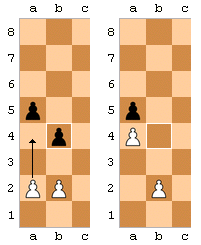
Trying to capture a pawn that’s been sitting there. A pawn that has occupied a square beside yours for several moves, having advanced two squares at some earlier point in the game, cannot suddenly become capturable en passant just because a player finally notices the geometry. The diagram below is the classic illustration of the trap: the position on the board looks identical to a legal en passant setup, but the capture is illegal because the neighboring pawn didn’t just move. What matters is the move that was just played, not the position that happens to be sitting in front of you.
How to improve your pawn play
En passant itself doesn’t need much drilling once the rule clicks. It’s binary: either the position qualifies, or it doesn’t. What’s worth building is the broader pawn judgment that makes a player notice the opportunity in the first place, which pawn break opens a file, when a two-square advance is walking straight into a capture, when it’s actually better to decline an en passant capture because the enemy pawn is doing more damage to its own structure by staying put. That’s pawn structure, not tactics, and it’s a separate skill from memorizing the rule.
For the most direct path to that skill, Pawn Structure Chess (affiliate) by Andrew Soltis breaks pawn formations down by type, isolated pawns, pawn islands, hanging pawns, majorities, and shows what each one is actually worth over the course of a game. It’s the standard reference for exactly this kind of pattern recognition, and it changes how a player looks at every pawn on the board, not only the ones standing next to each other for one fleeting move.
For the notation used throughout this article, see our chess notation guide. For what happens when a pawn survives all the way down the board instead of getting picked off along the way, see pawn promotion. New to the rules in general, start with chess for beginners, and once en passant is second nature, chess tactics is the next skill worth building. The French Defense that Gundersen and Faul were playing above gets its own full breakdown in our French Defense guide.

Sources
- FIDE Laws of Chess, Article 3.7.3 (en passant)
- En passant, Wikipedia
- Gunnar Gundersen vs A H Faul, Melbourne Christmas Tourney 1928-29, on chessgames.com
- Winter, Edward. “En passant (Chess).” chesshistory.com.
- Michael Adams vs Semen I Dvoirys, 1993, on chessgames.com
- “Fischer, Tal, and the most frequently forgotten chess rule.” Chess.com.
This page contains affiliate links. As an Amazon Associate, DiscussChess earns from qualifying purchases.
Sources
- FIDE Laws of Chess, Article 3.7.3 (en passant)
- En passant, Wikipedia (rule history, adoption by region)
- Gunnar Gundersen vs A H Faul, Melbourne Christmas Tourney 1928-29, chessgames.com
- Edward Winter, 'En passant (Chess),' chesshistory.com
- Michael Adams vs Semen I Dvoirys, 1993, chessgames.com
- 'Fischer, Tal, and the most frequently forgotten chess rule,' Chess.com
Further reading
- Pawn Structure Chess, Andrew Soltis ASIN verified via Open Library and Amazon 2026-07-12. Batsford algebraic edition. The standard reference for what different pawn formations are actually worth, the judgment that makes a player notice an en passant opportunity in the first place.