Wilhelm Steinitz: First World Chess Champion
Wilhelm Steinitz won the first World Chess Championship in 1886 at age 50 and held it until 1894. He also invented modern positional chess theory, the idea that small advantages accumulate and that sound defense beats reckless attack.
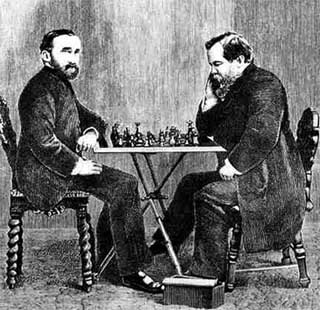
Wilhelm Steinitz was born May 14, 1836, in Prague’s Jewish ghetto and died August 12, 1900, of a heart attack at Manhattan State Hospital on Wards Island, New York, a pauper. He was the first universally recognized World Chess Champion, winning the title in 1886 by defeating Johannes Zukertort 12.5–7.5 in matches played across New York, St. Louis, and New Orleans. He held it until 1894, when Emanuel Lasker beat him 10 wins to 5, with 4 draws.
He also did something arguably more important than winning the first title: he invented the theory of positional chess. Before Steinitz, chess theory amounted to “attack aggressively and hope it connects,” the Romantic-era style that made the game entertaining and, by modern standards, deeply unsound. Steinitz showed that sound defense beats reckless attack, that positions should be evaluated for small, accumulating structural advantages rather than immediate tactics, and that piece coordination matters as much as tactical imagination. That framework, largely unchanged, is still how chess is taught and analyzed today.
Early career: from Prague to London
Steinitz studied mathematics for two years at the Vienna Polytechnic starting in 1857 and quickly climbed the local tournament scene, finishing third in 1859, second in 1860, third again in 1861, and winning outright in 1862 with 30 points from 31 games, a result that earned him the nickname “the Austrian Morphy.” He moved to London that year, finished sixth at the 1862 International Tournament but won its brilliancy prize, and then ran off a string of one-sided match wins against the era’s strong players: Serafino Dubois, Joseph Blackburne (twice; Blackburne had only played chess for two years at the time), Frederick Deacon, Augustus Mongredien, and Valentine Green. His early style was purely tactical and aggressive, consistent with the Romantic era, when sacrifice and direct assault were the default approach for every serious player.
The turning point was his 1866 match against Adolf Anderssen, then recognized as the world’s strongest player. The match was tied 6–6 after twelve games; Steinitz won the final two to take it 8–6, no draws, for a prize of £100 to his £20, a substantial sum for the time. The win established him as the world’s best player, a status without a formal title until two decades later.
In the 1870s his style transformed completely. He began playing defensively wherever defense was objectively correct, attacking only once the position genuinely justified it. Opponents, and much of the chess press, found this passive, even cowardly. Adolf Anderssen himself put it memorably: “Kolisch is a highwayman and points the pistol at your breast. Steinitz is a pick-pocket, he steals a pawn and wins a game with it.” Steinitz found it winning, going years between losses, and he eventually articulated the underlying theory in full: accumulate small advantages, convert them gradually, never attack before the position is ready. Every serious player who came after him built on that idea, whether they credited him for it or not.
Nine years away from the board, and a fight conducted in print
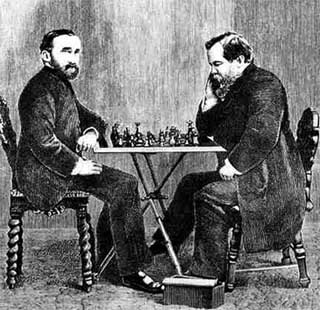
Between 1873 and 1882, Steinitz played no tournaments at all and only a single match, a 7–0 win over Blackburne in 1876. Instead he wrote for The Field, then Britain’s leading sports magazine, from 1873 to 1882, and spent much of that decade locked in what became known as the “Ink War,” a running, often vicious public argument with Johannes Zukertort and Leopold Hoffer over chess theory and, increasingly, over each other’s character. He returned to competition at Vienna 1882, tying for first with Szymon Winawer, then toured the United States from December 1882 to May 1883, winning matches against Alexander Sellman and Celso Golmayo Zúpide, before finishing second to Zukertort at London 1883.
Steinitz moved permanently to New York in 1883 and became a naturalized US citizen on November 23, 1888, formally changing his name from Wilhelm to William. In 1885 he founded and edited his own International Chess Magazine, running it until 1895, using its pages to negotiate the terms of the match that would finally settle, on the board rather than in print, who the strongest player in the world actually was.
The 1886 championship, and defenses that lasted eight years
The 1886 match against Zukertort, contested across New York, St. Louis, and New Orleans, was explicitly contracted “for the Championship of the World,” the first time the phrase carried that formal weight. Zukertort led 4–1 after the New York games, but Steinitz won decisively from there, taking all but one of the remaining fifteen games, and became the first official World Chess Champion on March 29, 1886, at 50 years old, still the oldest player ever to win a championship match for the first time.
He defended the title four times before finally losing it: against Chigorin in 1889 (10.5–6.5), Gunsberg in 1890–91 (10.5–8.5), Chigorin again in 1892 (12.5–10.5), and Lasker in 1894 (5–10). Siegbert Tarrasch had declined a championship challenge in 1892, citing the demands of his medical practice; had he accepted, chess history’s most anticipated matchup of the era might have happened years earlier than it eventually did between Tarrasch and Lasker.
The Lasker match made the age gap brutally clear: Steinitz was 57, Lasker 25, a 32-year difference that remains the largest in world championship history. A requested rematch in 1896–97 went even worse, 2–10 to Lasker, and after it Steinitz suffered a genuine mental breakdown, spending 40 days confined in a Moscow sanatorium. He kept playing tournaments until he died in 1900, never seriously threatening to recapture the title.
A brilliancy at 59, and a pauper’s death
Even in decline, Steinitz could still produce world-class attacking chess when the position called for it, ironic for the man who had spent two decades arguing defense was usually correct. At Hastings 1895, at 59 and finishing only fifth in the tournament, he beat Curt von Bardeleben with a combination still taught today: 22.Rxe7+ Kf8 23.Rf7+ Kg8 24.Rg7+ Kh8 25.Rxh7+, with Black facing forced mate and simply walking away from the board rather than resigning formally.
His final years were defined by financial collapse. He had offered to play the 1886 championship match against Zukertort for free at one point, agreed to reduced stakes in his 1894 match with Lasker, and by the end was surviving on almost nothing; his widow ran a small shop after his death to get by. Lasker, the man who took his title, wrote plainly of the debt owed him: “I who vanquished him must see to it that his great achievement, his theories should find justice.”
Legacy
Steinitz’s Modern Chess Instructor (1889) codified his positional principles in writing for the first time, and his contributions outlasted his eight-year championship by generations. Capablanca’s endgame precision, Karpov’s patient accumulation of small advantages, and the way modern chess engines actually evaluate positions all rest on Steinitzian principles: control the center, coordinate the pieces, and understand that defense, played correctly, is not a lesser choice than attack. Modern statistical analysis has been kind to him in ways his bank account never was: Jeff Sonas’s Chessmetrics work found Steinitz further ahead of his contemporaries in the 1870s than Bobby Fischer was during his own 1970–72 peak, and ranks him third all-time in total years spent as the world’s best player, behind only Lasker and Kasparov.
Kasparov’s My Great Predecessors Part 1 (affiliate) opens with Steinitz and remains the best annotated introduction to his games.
Steinitz vs. Zukertort, World Chess Championship 1886, Game 20
The match’s twentieth and final game, played in New Orleans on March 29, 1886, gave Steinitz his tenth win and the title outright. Zukertort’s knight wanders to h6 on move 15, and Steinitz answers with a bishop sacrifice, a rook sacrifice, and a knight fork that nets the queen. Three moves, one combination, one World Champion.
Steinitz, Wilhelm White Zukertort, Johannes Black


Sources
- Hooper, David, and Kenneth Whyld. The Oxford Companion to Chess. Oxford University Press, 1992.
- Steinitz, Wilhelm. The Modern Chess Instructor. 1889.
- Wilhelm Steinitz, Wikipedia (cross-checked against cited primary sources)
- Kasparov, Garry. My Great Predecessors, Part 1. Everyman Chess, 2003. (affiliate)
This page contains affiliate links. As an Amazon Associate, DiscussChess earns from qualifying purchases.
Sources
- Hooper, David, and Kenneth Whyld. The Oxford Companion to Chess. Oxford University Press, 1992.
- Steinitz, Wilhelm. The Modern Chess Instructor. 1889.
- Wilhelm Steinitz, Wikipedia (cross-checked against cited primary sources)
Further reading
- Garry Kasparov on My Great Predecessors, Part 1, Everyman Chess, 2003 ASIN verified via Open Library 2026-05-02. Kasparov opens with Steinitz, annotating his matches against Zukertort and Chigorin and explaining his theoretical contributions.