R. Praggnanandhaa: India's Prodigy, GM at 12
Rameshbabu Praggnanandhaa became the youngest International Master at 10 and one of the youngest grandmasters at 12. He reached the 2023 World Cup final, beat Magnus Carlsen twice in the same 2026 tournament, and climbed to world No. 4. The complete biography.
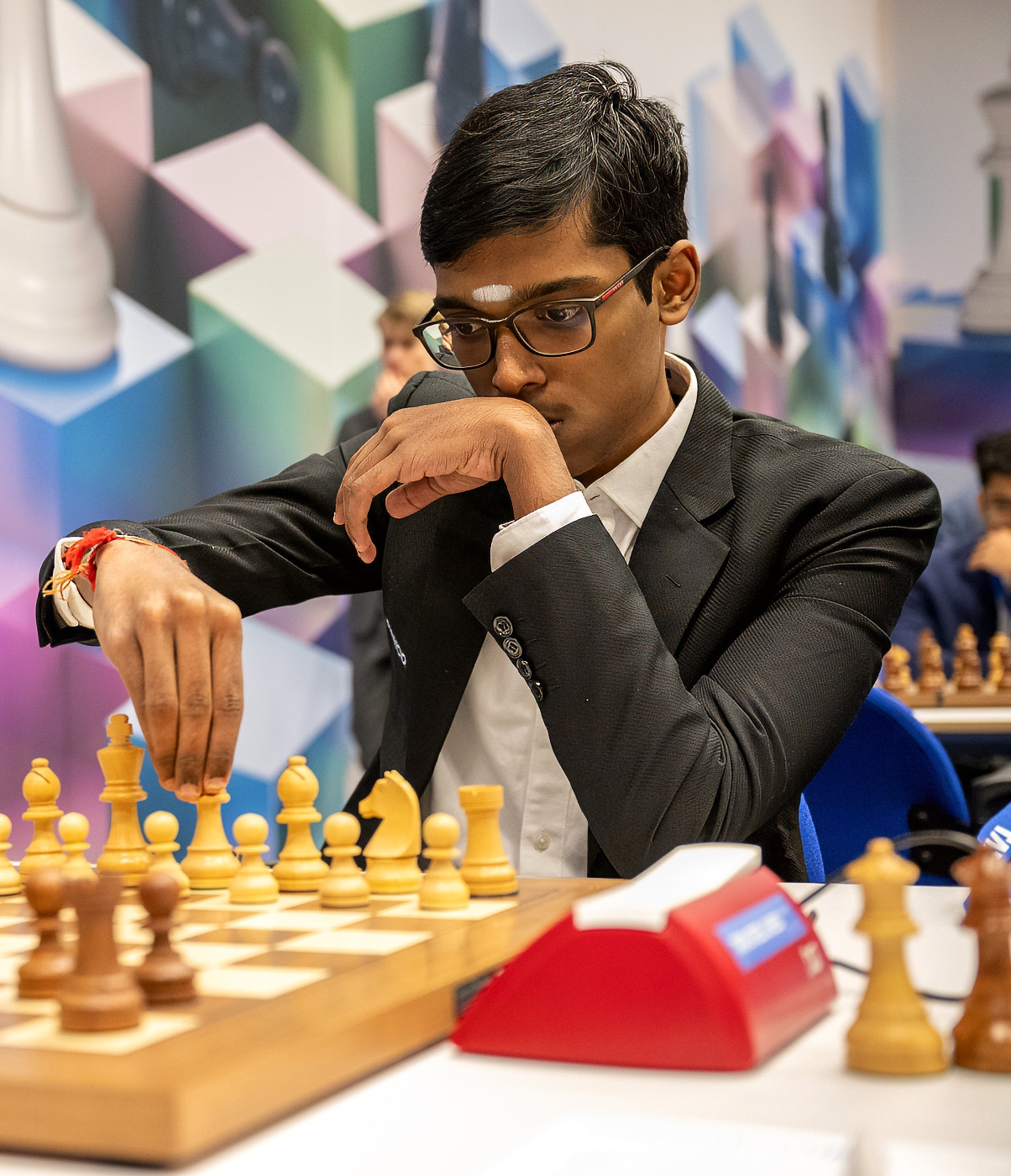
Rameshbabu Praggnanandhaa, universally called Pragg, was born August 10, 2005, in Chennai, India, making him 20 years old as of 2026. He won the World Youth Under-8 Championship in 2013, earning his first FIDE title at seven, and became the youngest International Master in history at 10 years, 10 months, and 19 days in 2016. He became a grandmaster at 12 years, 10 months, 13 days in 2018, the second-youngest at the time. He reached the FIDE World Cup final in 2023, losing to Magnus Carlsen only in tiebreaks, and in 2026 he became the first player in nearly two decades to beat Carlsen twice in classical chess within a single tournament. He is a fixture of the world’s top 15, having reached a peak of world No. 4 in July 2025.
His name is pronounced “prag-nah-NAN-da,” from the Sanskrit “pragya” (wisdom) and “ananda” (bliss). The common spelling confusion is real and universal, even commentators at major tournaments pause before saying it.
Early development
Pragg grew up in the same Chennai chess ecosystem that produced Viswanathan Anand and Gukesh Dommaraju. His sister Vaishali Rameshbabu is also a grandmaster; the two of them became the first brother-sister pair in history to both hold the GM title, and later the first brother-sister pair to both qualify for a Candidates Tournament. Chess as a family enterprise is part of the Chennai tradition, and the Rameshbabu household is its most visible modern example.
His junior results form an unusually clean staircase. World Youth Under-8 champion in 2013. World Youth Under-10 champion in 2015. Youngest International Master in history in 2016, younger than Carlsen was at the equivalent milestone. His first grandmaster norm came at the World Junior Championship in November 2017, where he finished fourth with 8 points; his second followed at the Heraklion Fischer Memorial in April 2018; his third came at the Gredine Open in Italy on June 23, 2018, completing the title at 12 years, 10 months, and 13 days.
He kept climbing after the title arrived. He won the Xtracon Chess Open in Denmark in July 2019 with 8.5/10, took the World Youth Under-18 title that October with 9/11, and in December 2019, at 14 years, 3 months, and 24 days, became the second-youngest player ever to cross 2600 FIDE.
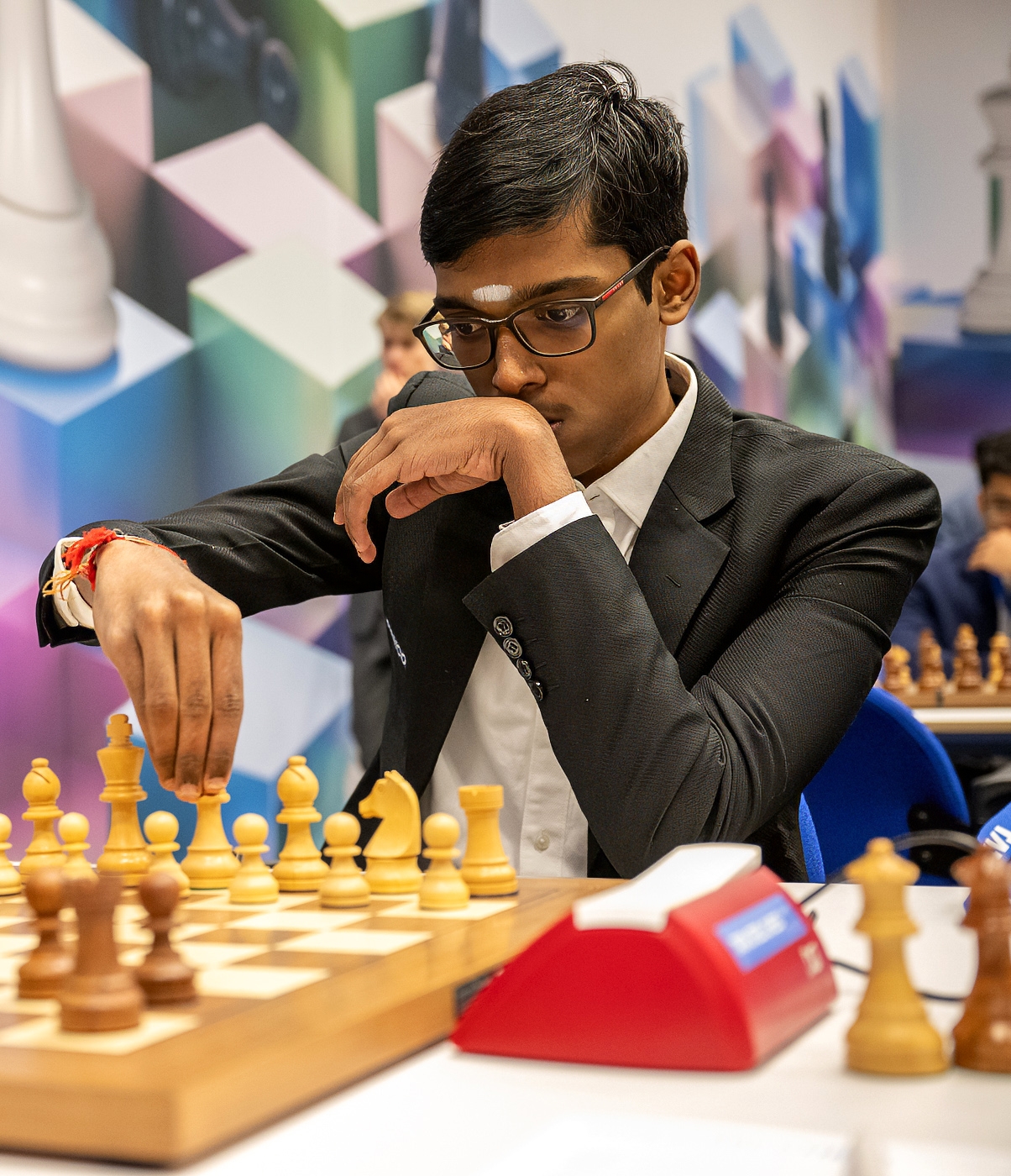
Beating Carlsen before he was old enough to drive in most US states
Pragg’s results against Magnus Carlsen became a running story of their own well before he was out of his teens. On February 20, 2022, he beat Carlsen in a 15+10 rapid game at the Airthings Masters, becoming only the third Indian player ever to defeat Carlsen, after Anand and Pentala Harikrishna. He beat him again three months later at the Chessable Masters, advancing to the finals, and beat him three separate times that August at the FTX Crypto Cup on his way to a runner-up finish. In between, he won the 2022 Asian Continental Championship outright with 7/9. He was 16 years old for most of that year.
2023: the youngest-ever World Cup finalist
The 2023 FIDE World Cup in Baku, Azerbaijan was a 206-player knockout. Pragg beat a string of top-20 players on his way to the final, including a technical conversion against Caruana in the semifinal, and became the youngest player in the event’s history to reach a World Cup final at 18. In the final, he faced Carlsen: classical games finished 1-1, and Carlsen won on rapid tiebreaks. Second place still put Pragg among the year’s standout performers and earned him a berth in the 2024 Candidates Tournament. Earlier that January, at Tata Steel in Wijk aan Zee, he’d already beaten Ding Liren in classical chess for the first time, on his way to a 9th-place finish (6/13) in a field of world championship-level players.
His 2024 Candidates performance was competitive without producing a championship match berth, finishing 5th of 8 with 7/14. The gap between “top-10 performer” and “Candidates winner” is substantial, everyone in that field is a potential champion, but the progression was clear. That April at Norway Chess, in Round 3, he beat Carlsen in classical chess for the first time in an over-the-board tournament game, a distinct milestone from the rapid and online wins that had piled up since 2022.
January 2025: the first major classical title
In January 2025, he added a different kind of result: winning the 87th Tata Steel Chess Masters in Wijk aan Zee in a three-game playoff against Gukesh, his first major classical super-tournament title. Both leaders lost their final classical games, tied on 8.5/13, and Pragg won the sudden-death tiebreak. The deciding game, Pragg as White in the London System, 62 moves, is below.
Praggnanandhaa R White Gukesh D Black


Playing style
Pragg plays actively. He looks for imbalances, creates complications early, and is comfortable in positions where both sides have genuine winning chances. He’s less of a grinder than Kramnik and less of a pure attacker than Tal, his games tend to feature sharp positions where precise calculation matters.
He plays the Sicilian Defense frequently as Black. As White he uses 1.e4 and 1.d4 interchangeably, which makes preparation against him difficult. His endgame technique is strong enough that complications don’t have to win outright. He can create enough pressure that opponents make errors in difficult positions, which is exactly what happened to Gukesh in the Tata Steel tiebreak above.
2025-2026: the double win over Carlsen
2025 was Pragg’s most consistent year at the elite level. He finished third at the Prague Chess Festival, won the GCT Superbet Romania rapid and blitz event with a playoff win over Vachier-Lagrave and Firouzja, took the UzChess Cup on blitz tiebreaks, and by July 2025 had climbed to world No. 4, the highest ranking of his career and the top spot among all Indian players, ahead of Gukesh. He reached the Grand Chess Tour finals in São Paulo before losing in the semifinal, and a 2025 FIDE Circuit win qualified him for the 2026 Candidates Tournament.
That 2026 Candidates, held in Pegeia, Cyprus, didn’t go his way on the scoreboard: he finished 7th of 8 with 6/14, and lost both his individual games to eventual winner Javokhir Sindarov, “the double” that helped seal Sindarov’s title challenge. But the year’s defining result came afterward, at Norway Chess 2026, where Pragg beat Carlsen in classical chess twice in the same event, in Rounds 3 and 8, on his way to winning the open section outright. No player had beaten Carlsen twice classically in a single tournament since Veselin Topalov did it in 2008, back when Carlsen himself was still a teenager working his own way up the rating list.
India’s chess generation
Pragg is part of the wave of Indian chess talent that has dominated world rankings since 2021. Gukesh Dommaraju won the world championship in 2024. Nihal Sarin, Arjun Erigaisi, and Pragg himself have all been ranked in the world’s top 10 or close to it, and Vaishali won gold with the Indian women’s team at the 2024 Chess Olympiad. The concentration of Indian talent at the top level is historically unprecedented outside the Soviet chess program, and Pragg has picked up national recognition to match it: the Arjuna Award in 2022 and CNN-News18’s Indian of the Year in Sports for 2023.
See our Viswanathan Anand biography for the history of how India built this infrastructure. The ecosystem Anand helped create in Chennai is producing multiple generations of elite players, and Pragg, at 20, is still one of the youngest names doing the producing.
Sources
- FIDE Rating Profile: R. Praggnanandhaa
- FIDE World Cup 2023: official results
- Rameshbabu Praggnanandhaa, Wikipedia
- Silman, Jeremy. Silman’s Complete Endgame Course. Siles Press, 2007. (affiliate)
This page contains affiliate links. As an Amazon Associate, DiscussChess earns from qualifying purchases.
Sources
Further reading
- Silman's Complete Endgame Course, Jeremy Silman ASIN verified via Open Library 2026-05-02. Pragg's endgame precision is the technical foundation under his attacking style.