The Opera Game: Morphy's 1858 Masterpiece
Morphy vs. Duke of Brunswick and Count Isouard, Paris Opera 1858. White sacrificed a bishop, a rook, and delivered checkmate in 17 moves against two opponents consulting together. The most famous casual game in chess history, played in a box at the Paris Opera.
The Opera Game was played in a box at the Salle Le Peletier, the Paris Opéra’s home at the time, sometime in late October or early November 1858. Nobody recorded the exact date, and chess historians still argue over which opera was on stage that night. Some accounts say Rossini’s Il barbiere di Siviglia; the chess historian Edward Winter has argued the evidence points at least as strongly toward Bellini’s Norma. What’s certain is that Paul Morphy, the strongest chess player alive and already a celebrity on his European tour, was invited to play a casual game against two aristocratic amateurs sharing a box: Duke Karl II of Brunswick, a German nobleman known for financing an opera company of his own, and the Count Isouard de Vauvenargues, a French aristocrat. The two opponents consulted together on every move, effectively playing as one mind against Morphy’s one. Morphy won in 17 moves with a rook sacrifice on move 13, a queen sacrifice on move 16, and checkmate on move 17.
It is the most famous casual game in chess history. More people have studied this game than any professional tournament game of the 19th century, because the principles it demonstrates, rapid development and attacking the uncastled king, are the foundation of how chess is taught to beginners. The final mating pattern, where every remaining White piece participates in the checkmate with nothing to spare, is common enough in instructional material that it has its own name among trainers: the “opera mate.”
The game
White: Paul Morphy. Black: Duke of Brunswick and Count Isouard (consulting).
Morphy plays the Philidor Defense structure out of 1.e4 e5, then tears it apart. By move 9 he has every piece active, Black hasn’t castled, and the d-file is open. The rest is a forced mating attack built on two sacrifices: a rook and then his queen.
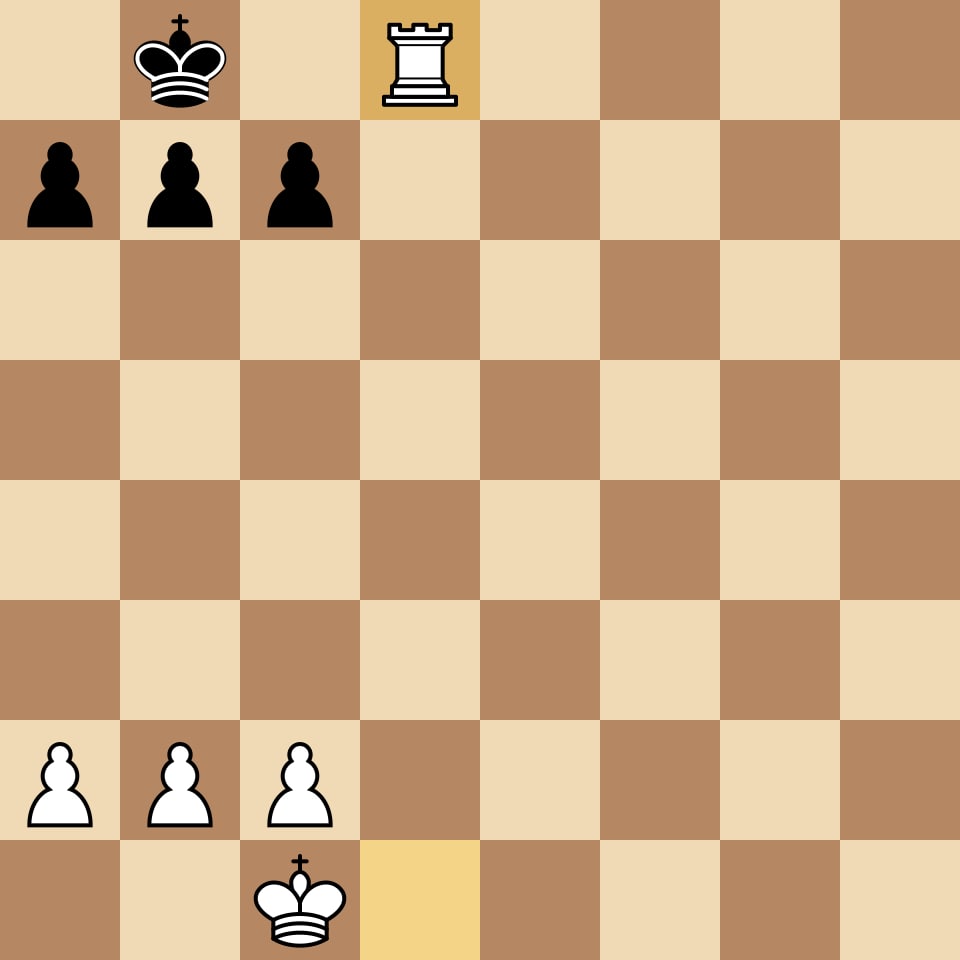
16.Qb8+!!, the queen flies into Black’s back rank. After 16…Nxb8, the knight that was guarding d8 is gone. 17.Rd8# is checkmate. Two opponents consulting together, and they couldn’t find a defense.
Morphy White Duke of Brunswick & Count Isouard Black


Why it works
Every Morphy move follows one principle: develop rapidly and attack the uncastled king. Black’s position at the end shows exactly what happens when those principles are violated.
Move 3 (3…Bg4): Black develops the bishop but pins the f3 knight. Morphy immediately breaks the pin (4.dxe5) and captures the bishop (5.Qxf3), trading Black’s only developed piece. Black is now behind in development.
Moves 6–7 (6.Bc4, 7.Qb3): Morphy develops his bishop to c4, eyeing f7, and follows with his queen to b3, attacking both b7 and f7 simultaneously. The consulting Black side has to answer both threats with one move, and 7…Qe7 is the only piece that can cover both squares. It’s a defensive necessity that comes at a real cost: Black’s own queen now sits on the square the king would need to castle through, so Black’s king is stuck in the center for the rest of the game while Morphy keeps developing.
Move 9 (9…b5): Black tries to attack Morphy’s bishop on c4 with a pawn. Morphy ignores the threat and sacrifices the knight on b5 (10.Nxb5). Two pieces are hanging, but Black’s king hasn’t castled. Morphy’s bishops are now aimed at the uncastled king.
Moves 11–12 (11.Bxb5+, 12.O-O-O): The bishop recaptures on b5 with check, and instead of stopping to consolidate his material, Morphy castles queenside on move 12, putting his rook on d1 with tempo against Black’s position in the same motion. Every one of Morphy’s pieces is now working; Black is still trying to untangle a king stuck behind pawns that never got to castle at all.

Moves 12–17: Morphy doubles rooks on the d-file. The sacrifice sequence: rook takes knight (13.Rxd7), other rook comes to d1 (14.Rd1), bishop takes the other knight with check (15.Bxd7+), queen sacrifice to deflect the knight from the back rank (16.Qb8+), and Rd8 checkmate.
The combination is forced once Black’s pieces are all on the back two ranks. But it required Morphy to calculate correctly from move 10 onward, sacrificing two pieces before he had the mating position in sight.
Paul Morphy and the Opera Game’s legacy
Morphy (1837–1884) was the dominant player of his era. He visited Europe in 1858, played every strong player he could find, and demolished all of them, including a lopsided match win over Adolf Anderssen, the man who’d played the Immortal Game seven years earlier and was considered Europe’s strongest active master. Then he retired from competitive chess at 21, having proved whatever he set out to prove, and spent the rest of his life largely away from the game. The Opera Game isn’t even one of his tournament or match wins; it’s a casual game he probably didn’t think twice about afterward. It became the most studied of his games precisely because it’s short, instructive, and the combination is clear enough for beginners to follow from the first move to the mate.
The Duke of Brunswick, for his part, wasn’t a random aristocrat who happened to be in the box. Karl II had ruled the Duchy of Brunswick until a September 1830 revolt burned his palace and forced him into decades of exile across Spain, England, and France. By 1858 he’d settled into life as a fixture of Parisian high society, an opera lover who kept his own private box at the Salle Le Peletier, close enough to the stage, according to a Morphy associate, “to kiss the prima donna without any trouble.” That box reportedly always had a chess set in it, because the Duke was as serious about the game as he was about opera. That he and Isouard lost so completely, and consulted on every move without finding a single defensive resource, has become part of the game’s teaching value: it shows what happens when even two heads working together fall behind in development against a player who never wastes a tempo.
The game is used in chess instruction worldwide as the clearest demonstration of development principles: get your pieces out, don’t move them twice, attack the uncastled king. The Duke and Count broke every rule; Morphy punished every violation precisely.
Sources
- Sergeant, Philip W. Morphy’s Games of Chess. Dover, 1957.
- Hooper, David, and Kenneth Whyld. The Oxford Companion to Chess. Oxford University Press, 1992.
- Opera Game (1858), Lichess study (PGN source)
- Fischer, Bobby. My 60 Memorable Games. Batsford/Pavilion. (affiliate)
This page contains affiliate links. As an Amazon Associate, DiscussChess earns from qualifying purchases.
Sources
- Sergeant, Philip W. Morphy's Games of Chess. Dover, 1957.
- Hooper, David, and Kenneth Whyld. The Oxford Companion to Chess. Oxford University Press, 1992.
- Opera Game (1858), Lichess study (PGN source)
- Morphy v the Duke and Count, Edward Winter, Chess History
- Charles II, Duke of Brunswick, Wikipedia
Further reading
- My 60 Memorable Games, Bobby Fischer ASIN verified via Open Library 2026-05-02. Fischer's annotated collection is the natural companion to studying classic games like the Opera Game, demonstrating how attacking principles carry forward across eras.
- Logical Chess: Move by Move, Irving Chernev ASIN verified via Open Library 2026-05-02. Chernev's annotated games show how Morphy's development principles (pieces out, center, king safety) apply to every era of chess.