Freestyle Chess GOAT Challenge Explained
Backed by $12 million in private funding, the Freestyle Chess G.O.A.T. Challenge series plays Chess960, every game starts from a randomized position, eliminating opening preparation entirely. Carlsen won the 2024 debut, then got knocked out by a mid-pack Vincent Keymer at his own tour's 2025 opener. Here's what it is and why it matters.
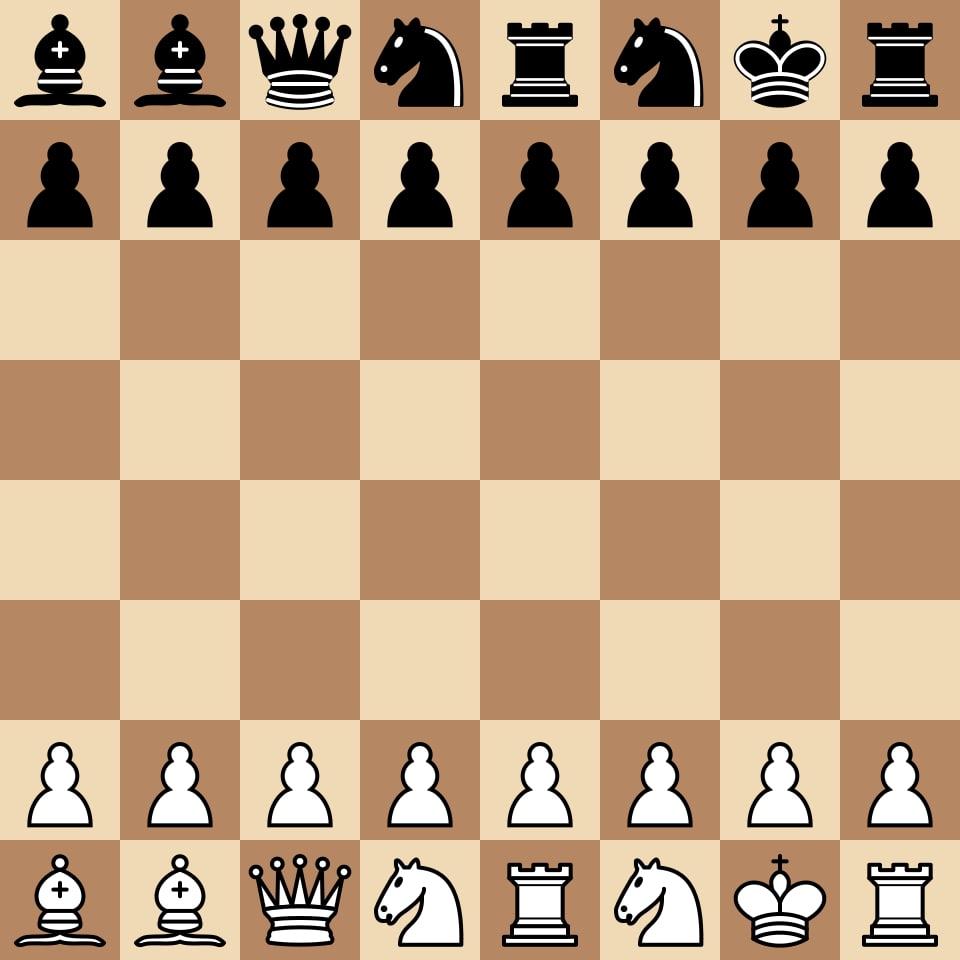
Bobby Fischer invented Chess960 in 1996, announcing the format in Buenos Aires. The idea was simple and pointed: standard chess had been corrupted by memorization. Players were spending years studying opening theory, preparing home analysis of specific positions, and reaching the middle game with ten or fifteen moves already played from memory. Fischer thought that wasn’t chess. It was preparation.
His solution was randomization. In Chess960, the starting position of the pieces is drawn from 960 possible configurations before each game. Pawns stay in their standard row. Everything behind them is random. You can’t prepare the first fifteen moves because nobody knows what position you’re starting from.
Fischer’s idea stayed at the margins of elite chess for nearly three decades. Then Magnus Carlsen decided to make it the future of the game.
What the Freestyle Chess G.O.A.T. Challenge is
The Freestyle Chess G.O.A.T. Challenge is a series of elite events backed by $12 million in private funding, purpose-built around Chess960. The branding is Carlsen-adjacent, “G.O.A.T.” is not subtle, and the format is explicitly designed to test chess-thinking ability without the preparation layer that dominates classical play at the top level. It’s organized and sponsored by Jan Henric Buettner, owner of the Weissenhaus resort in Germany, whom Carlsen reportedly pitched on the idea of a slow-time-control Chess960 event when the two met at the 2023 Qatar Masters. Carlsen serves as co-organizer, not just a marquee player.
The first event ran February 9–16, 2024, at Weissenhaus: an 8-player field (Carlsen, Ding Liren, Caruana, Firouzja, Gukesh, Abdusattorov, Keymer, and Aronian) competing for a $200,000 prize pool over a rapid round-robin preliminary that seeded a classical knockout final. That distinction matters: unlike most Chess960 events, which are played at rapid or blitz speeds, this was the first major Chess960 tournament ever held at full classical time controls, the same format Carlsen has argued should eventually replace the standard game.
Abdusattorov won the rapid preliminary, beating Carlsen in the final round to top the standings (which, if you’re tracking the Uzbek chess surge, is consistent). But the classical knockout that followed went the other way: Carlsen beat Caruana 3–1 across their final match to win the inaugural event outright. The debut belonged to Carlsen. It’s the sequel where the format bit back.
From one event to a tour, and the upset that actually happened
What started as a single Weissenhaus experiment grew fast. Plans for a multi-continent tour were announced for 2025, with events originally floated for India, New York, Cartagena, and Cape Town on top of a return to Weissenhaus, before the India leg was shelved that spring. What actually happened: three confirmed 2025 events, Weissenhaus in February, New York in July, and Cape Town in December, each carrying a $750,000 prize fund, with organizers signaling a jump to $1 million per event for future legs. The series was formally renamed the Freestyle Chess Grand Slam Tour, and the field for the 2025 Weissenhaus opener expanded to ten players, adding Nakamura, Fedoseev, and Sindarov to the previous year’s lineup.
This is where the real upset happened. In the nine-round preliminary, Firouzja and Sindarov tied for first at 6.5 points, Caruana was third with 6, Carlsen finished fourth with 5.5, and Vincent Keymer limped into the knockout bracket in sixth place with just 4. None of that predicted what followed: Keymer beat Carlsen in the semifinal, then beat Caruana 1.5–0.5 in the final, going through the entire knockout stage undefeated after finishing mid-pack in the round-robin. Carlsen took third by beating Sindarov in the bronze-medal match, a strange position for the tour’s own co-organizer and most famous evangelist to end up in at his own event’s opening stop of the year.
The Paris stop in April 2025 restored some of the expected order: an all-Carlsen-Nakamura final that lived up to the hype, with Carlsen coming out on top. The Las Vegas leg followed in July. Players scored tour points by placement at each event, with the highest season total crowning the year’s Freestyle Chess champion, a structure much closer to a golf or tennis tour than to a traditional chess calendar built around one-off invitationals.
Carlsen’s 2900 rating in freestyle
When the Freestyle Chess circuit introduced its own rating system, Carlsen hit 2900. That number is worth reading carefully. His FIDE classical rating peaked at 2882 in May 2014, the all-time record. In the freestyle rating, stripped of opening preparation, he rated higher.
The implication Carlsen draws from this isn’t subtle: his actual chess ability is above what the classical rating captures, because the classical game contains a preparation component that compresses the real skill differences between players. In Chess960, where everyone starts blind on move one, the gap becomes more visible.
Whether you buy that argument depends on how much you think opening preparation is “real” chess versus an adjacent skill. The elite chess world is split. Caruana and Nakamura have both been candid that their opening preparation is a major part of their competitive advantage; stripping it out isn’t obviously fair to players who’ve invested years in that area. Carlsen has always been less dependent on preparation and more dependent on middlegame calculation and endgame technique.
It’s a genuine debate, and the Freestyle series is the first well-funded institutional attempt to test the question rather than just argue about it.
Why this is worth following
The series is new, the funding is substantial, and the players who participate are the same ones competing in FIDE classical events. Keymer’s Weissenhaus win was notable not just for the result but for what it suggested: in Chess960, the hierarchy shifts. Players who are elite tacticians but slightly below the top in classical opening preparation can compete on more equal footing.
For context on Fischer’s original thinking and career, his My 60 Memorable Games annotates his best work in classical chess and gives a sense of the attacking instincts he was worried would be smothered by preparation. David Shenk’s The Immortal Game is the best general-audience history of chess for understanding why format debates about the game keep reoccurring. See also our Bobby Fischer profile and Carlsen’s full biography for the two players most associated with this format argument.
Sources
This page contains affiliate links. As an Amazon Associate, DiscussChess earns from qualifying purchases.
Sources
- Freestyle Chess G.O.A.T. Challenge, Wikipedia
- $12 million Raised For 'Revolutionary' Freestyle Series, Chess.com
- Magnus Carlsen Hits 2900 As Freestyle Chess Introduces New Ratings, Chess.com
- Freestyle Grand Slam Weissenhaus 2025, The Week in Chess
- Freestyle Chess Grand Slam Tour, Wikipedia
- Weissenhaus Freestyle Chess Day 8: Undefeated Keymer Wins Weissenhaus Knockout, Chess.com
Further reading
- My 60 Memorable Games, Bobby Fischer ASIN verified via Open Library 2026-05-02. Batsford 1995 edition. Fischer invented Chess960 in 1996. His annotated games show the attacking instincts that made him argue preparation was corrupting the game.
- The Immortal Game: A History of Chess, David Shenk ASIN verified via Open Library 2026-05-02. Knopf Doubleday 2006. The best general-audience history of chess for understanding why format debates about the game keep recurring.
- DGT 3000 Digital Chess Clock ASIN verified via Amazon 2026-05-02. Used at Freestyle Chess events.